
EV Charger Protection Guide: PME, RCBO & SPD by Brand
EV Charger Protection: PME, RCBO & SPD by Brand
Choose protection for Tesla, Zappi, Ohme, Hypervolt, Easee, Wallbox and Andersen chargers, with WCED buying routes for indoor, IP65 and three-phase installations.
EcoHarmony buying guide · Checked 1 November 2026
The short answer
Start with the exact charger model and supply arrangement. Built-in PEN protection does not automatically remove the need for an external RCBO or SPD. Equally, a charger with suitable PEN protection may not need another PME unit.
PME, RCBO, RCD and SPD: four separate buying checks
Choose protection for the chargepoint and supply circuit, not simply the car badge. A Tesla Model Y connected to a Hypervolt has different chargepoint documentation from a Tesla Wall Connector charging the same car.
| Protection | Purpose | What it does not establish |
|---|---|---|
| PME / open-PEN device | Addresses a specified broken supply PEN conductor risk | Not automatically an RCD, circuit breaker or SPD |
| RCD / RCBO | Residual-current protection; an RCBO also includes overcurrent protection | Not automatically open-PEN or surge protection |
| 6mA DC detection / RDC-DD | Addresses DC residual current from EV charging | Not a substitute for every required 30mA AC RCD function |
| SPD / surge protection | Limits transient overvoltage | Does not replace an RCBO or PEN device |
For more detail, read RCBO vs MCB vs RCD and PME and PEN fault protection.
Charger-by-charger protection comparison
This table is a starting point for the named models, not an automatic compatibility certificate. Read the model notes below before selecting a WCED variant.
| Charger | PME / PEN check | RCD / RCBO check | Buying route |
|---|---|---|---|
| Tesla Wall Connector Gen 3, UK Type 2 | Assess external open-PEN protection on TN-C-S. Tesla’s UK manual explains the issue. | Built-in Type A residual-current function and 6mA DC detection do not settle all upstream requirements. | PME + RCBO assembly where specified; choose the required SPD option. |
| myenergi zappi, UK versions | The documented UK -G versions have PEN protection; do not apply this to every country version. | Check the exact generation’s RCD documentation and supply-circuit requirements. | RCBO + SPD assembly where specified; avoid adding PEN protection solely because it is an EV. |
| Ohme Home Pro / ePod, listed UK 7.4kW models | Built-in PEN detection is documented for the listed UK models. | Guide specifies separate overcurrent protection and addresses upstream Type A 30mA RCD protection. | Compare the specified single-phase RCBO assembly and assess surge protection. |
| Hypervolt Home 3 Pro | Built-in PEN protection. | External individual, double-pole Type A RCD protection is required; overcurrent protection is also external. | Compare the specified RCBO + SPD configuration and enclosure. |
| Easee One / Charge Up | Easee One is a UK single-phase model with open-PEN protection. Do not transfer this specification to Charge Up. | Charge Up’s manual sets conditions for its integrated RCD; check UK requirements and exact model. | Establish the full specification before choosing RCBO/SPD or PME equipment. |
| Wallbox Pulsar Max | The UK datasheet identifies an O-PEN part-number option. Verify the actual unit. | Datasheet lists 6mA DC detection and external Type A RCCB, subject to local requirements. | Match residual-current and overcurrent protection; add PEN equipment only if needed. |
| Andersen A3 | A3 installer documentation lists PEN detection. Check A2 or Quartz separately. | A3 manual recommends a 40A RCBO or Type A RCCB plus 40A MCB, B curve. | Compare an assembly matching that specification and assess SPD/enclosure needs. |
Tesla Wall Connector: do I need PME protection?
For Gen 3 installations on a UK TN-C-S supply, Tesla’s UK manual describes the need for external PEN fault detection and isolation in most scenarios. Its earth-monitoring function should not be treated as an equivalent open-PEN solution. Ask your installer to specify the earthing arrangement and required external protection.
Compare indoor WCED PME units and IP65 WCED PME units for single-phase installations, or use our Tesla Wall Connector protection guide for three-phase and multi-charger options. Tesla Gen 3 UK manual: earthing application note.
Does a Zappi need an external RCBO or PME unit?
myenergi distinguishes UK -G versions with PEN fault protection from other versions. It also publishes model-specific residual-current information and a statement explaining why older “no upstream RCD needed” advice should not be used as a universal rule. Identify the generation, full model suffix and relevant manual before buying.
If the installed model provides suitable PEN protection, the remaining purchase may be the specified RCBO and surge-protection assembly. Do not assume an older zappi document also covers zappi GLO. See myenergi: zappi versions and PEN fault detection, myenergi: statement on upstream RCDs and myenergi: model-specific document downloads.
Ohme Home Pro and ePod: what protection is still needed?
The UK 7.4kW installation guide lists built-in PEN detection, but separate overcurrent protection. It recommends a 40A B-curve MCB and says an upstream RCD, where required, must be at least Type A 30mA. An installer may specify a suitable RCBO assembly to combine the required functions. Here “B curve” describes overcurrent operation, not a Type B residual-current device.
Start with the installer’s specification, then compare IP65 plastic RCBO + SPD units or IP65 metal EV consumer units. Check curve, pole switching and residual-current characteristics rather than ordering on the 40A label alone. Source: Ohme Home Pro and ePod: UK/IE installation guide.
Hypervolt Home 3 Pro: RCBO and surge protection
Hypervolt documents built-in PEN protection and requires external RCD protection. Its installation guide specifies an individual, double-pole device of at least Type A and asks installers to consider the appropriate SPD type. The complete supply circuit still needs overcurrent protection.
Compare IP65 plastic RCBO + SPD units or IP65 metal EV consumer units once the installer has selected the current rating and curve. Built-in PEN protection is a reason to check whether a separate PME unit would duplicate an existing function. Source: Hypervolt Home 3 Pro: installation guide.
Easee One versus Charge Up: avoid mixing specifications
Easee One is a 7.4kW single-phase model advertised with open-PEN protection. Charge Up is a different product: its installer guide describes integrated AC/DC residual-current detection and conditions concerning external RCDs. A general international manual does not, by itself, establish that every proposed UK installation can omit an external device.
Get the exact UK model, country documentation and installation design confirmed before selecting a WCED unit. Sources: Easee One: UK single-phase model and Easee Charge Up: installer documents.
Wallbox Pulsar Max: check the UK O-PEN option
The UK Pulsar Max datasheet separates model options and identifies UK O-PEN protection in its part-number structure. It also lists 6mA DC detection and an external Type A RCCB requirement subject to local regulations. Do not treat all Pulsar Max, Pulsar Plus and Pulsar Pro units as identical.
Use the actual label and matching installation manual to determine PEN provision, phase arrangement, protective-device rating and curve. An RCCB also needs coordinated overcurrent protection. Source: Wallbox Pulsar Max: UK datasheet and part-number options.
Andersen A3: built-in PEN does not remove upstream protection
The A3 installer manual documents PEN detection and recommends a 40A RCBO, or a Type A RCCB with 40A B-curve MCB. That gives an installer a protection specification to check against a complete WCED assembly. Confirm environmental suitability and surge protection separately.
A2 and Quartz have their own manuals; do not assume that every Andersen generation uses the A3 specification. Source: Andersen: A2, A3 and Quartz installer manuals.
7kW, 11kW, 22kW and multiple chargers
At typical UK nominal voltages, 7.4kW charging is approximately 32A on one phase; 11kW is approximately 16A per phase and 22kW approximately 32A per phase on a three-phase supply. These are charging-current examples, not automatic breaker selections. The installer must account for the actual configured output and circuit design.
A 22kW charger does not become a 22kW installation on a single-phase supply, and the vehicle’s AC charging limit can reduce the delivered rate. For several chargers, establish each outgoing circuit, total supply capacity and load management. A TPN board’s main switch and SPD do not provide every charger’s individual residual-current or PEN protection.
Read WCED TPN board selection and compare multi-charger PEN protection assemblies.
WCED buying routes: indoor, IP65, single- and three-phase
Use these links after the protection specification is established. They open catalogue options, not a claim that every option fits every charger above. Current price and availability appear on the product page.
| Requirement | Compare these exact options |
|---|---|
| Single-phase RCBO + SPD, IP65 plastic | 32A option · 40A option |
| Single-phase RCBO + SPD, indoor | 32A option · 40A option |
| IP65 metal EV consumer unit | Compare 32A / 40A and switch options |
| Single-phase PME + SPD | Indoor PME + SPD option · IP65 PME + SPD option |
| Three-phase RCBO + SPD without listed PEN function | Indoor RCBO 32A · Indoor RCBO 40A · IP65 configurations |
| Three-phase PME + RCBO + SPD | 40A RCBO + surge option |
| Several chargers on a three-phase supply | Compare output phases and circuit counts |
IP65 addresses dust and water ingress under specified installation conditions. It does not guarantee suitability for every exposed location. An indoor IP30/IP40 unit has no water-ingress protection rating. See IP40 vs IP65 enclosures.
How installers use these WCED units
These accounts were supplied to EcoHarmony and are published with permission. They describe the installers’ product choices; the protection for each job still depends on the exact charger, supply and installation design.
Ohme: indoor or IP65 RCBO and surge protection
Mark Hennessy, Senior Electrician at Brightwell Electrical Services, uses the indoor RCBO + surge unit or IP65 RCBO + surge unit for Ohme installations, choosing the enclosure to suit the location.
Three-phase Pod Point: the IP65 RCBO option
Tom Fairweather, Site Supervisor at Ashgrove Electrical Contractors, uses the IP65 three-phase unit for Pod Point installations. Ashgrove selects the RCBO version and values the simplicity of the IP65 enclosure.
Single-phase Tesla: protection in the right enclosure
Callum Prentice, Domestic Installer at Harlow Electrical Solutions, uses indoor metal PME units and IP65 plastic PME units for single-phase Tesla installations. Harlow selects RCBO, surge and PEN protection together, choosing the enclosure for the installation location.
Three-phase Tesla: an RCBO-based PME assembly
Gareth Llewellyn, Inspection & Testing Engineer at Oakmoor Electrical & Testing, uses the RCBO version of the three-phase PME unit for Tesla installations. The product also offers other protective-device and surge options, so check the selected variant before ordering.
Multiple chargers: one protection enclosure
Dean Alderton, Project Manager at Northgate Electrical Services, uses the multi-charger PEN and surge protection unit. Northgate values having the equipment in one enclosure, with RCBO configurations for two or three three-phase chargers, or six single-phase circuits.
For your own project, match the exact charger model and installation requirements to the selected devices. An installer’s experience with one configuration does not establish compatibility with every model from that charger brand.
Buying questions
Does every EV charger need a PME protection unit?
No. The supply earthing, installation arrangement and charger’s built-in protection determine whether an external open-PEN device is needed. Check the exact model, not just the brand.
Does an RCBO with surge protection also provide PEN fault protection?
Not unless the assembly explicitly includes the required PEN function. RCBO, SPD and open-PEN detection are separate functions.
Is 6mA DC protection the same as a 30mA Type A RCD?
No. They address different residual-current characteristics. The installer must verify the complete protection arrangement and the relevant device standards; a feature label alone is insufficient.
Can I buy a 40A unit for any 7kW charger?
No. Check the manufacturer’s specified rating and curve, the supply-circuit design, all-live-conductor disconnection and board compatibility. A larger current rating is not an automatic upgrade.
Do I need an SPD if my main consumer unit already has one?
Assess the existing SPD arrangement, coordination, circuit distance and equipment requirements. A second SPD is neither automatically necessary nor automatically redundant. Read the surge-protection guide for the selection checks.
Does solar charging need a solar DC protection box on the charger circuit?
A normal AC EV charger remains connected to an AC supply circuit even when it uses surplus solar generation. PV DC combiner boxes belong on the solar array side of the inverter; they are not substitutes for the charger’s AC protection.
Can one RCD protect several charging points?
Do not assume a shared upstream RCD replaces the required individual protection for each charging point. Have the designer confirm the complete arrangement, including protection inside each charger and coordination upstream.
Find the specified WCED unit
Send us your charger model and UK part number, single- or three-phase supply, installation location and your electrician’s required protection specification. We can help locate the matching catalogue option and manufacturer information.
Manufacturer information and further reading
This guide supports product selection; it is not a wiring design or a declaration that a particular installation complies. Your qualified installer must confirm the exact model, current manufacturer instructions, applicable wiring requirements and any product safety notices. Built-in features can change between generations and country versions.
- Tesla UK: current Wall Connector installation guides
- Tesla Gen 3 UK manual: earthing application note
- Tesla Gen 3 Type 2: electrical specifications
- myenergi: zappi versions and PEN fault detection
- myenergi: statement on upstream RCDs
- myenergi: model-specific document downloads
- Ohme Home Pro and ePod: UK/IE installation guide
- Hypervolt Home 3 Pro: installation guide
- Easee One: UK single-phase model
- Easee Charge Up: installer documents
- Wallbox Pulsar Max: UK datasheet and part-number options
- Andersen: A2, A3 and Quartz installer manuals
- IET: RCDs for electric vehicle supply equipment
- WCED: PME units and model documentation
-
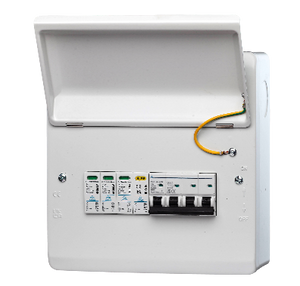
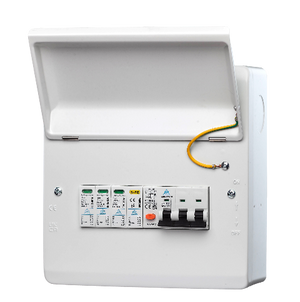
WCED Indoor 3-Phase Consumer Unit — RCBO or MCB + Surge Protection
Regular price From £65.00Regular price -


3-Phase PME PEN Fault Protection – 40A RCBO + Surge | Single EV Charger | BS7671 Compliant
Regular price From £65.00Regular price -
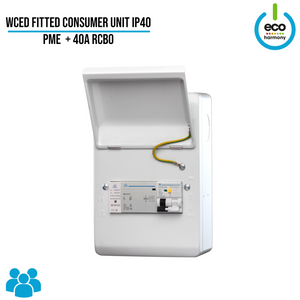
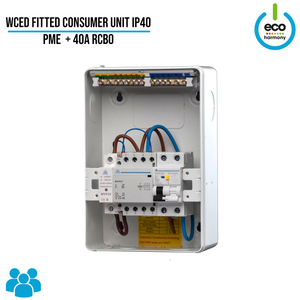
Fitted Consumer Unit IP40 – PME + 40A RCBO (Surge Protection + kWh Meter + Load Balancing Options Available)
Regular price From £80.00Regular price -
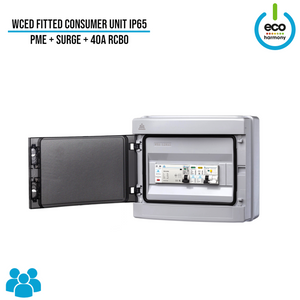
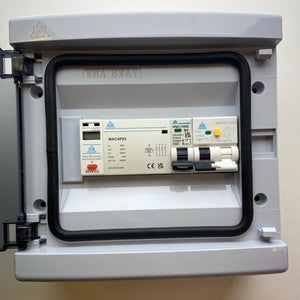
WCED PEN Fault Protection Unit — IP65, Optional Surge Protection
Regular price From £77.50Regular price -
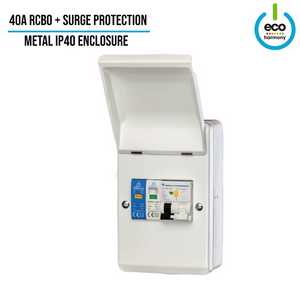
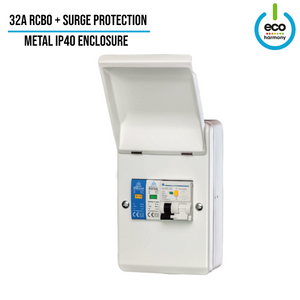
WCED IP40 EV Charger Consumer Unit – 32A or 40A C-Curve RCBO + Type 2 SPD
Regular price £32.50Regular price -
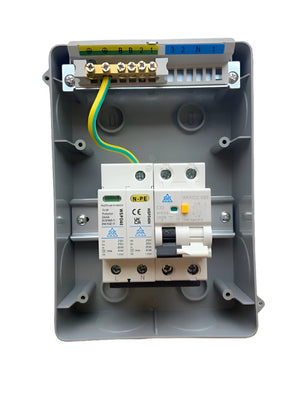
IP65 Consumer Unit with RCBO + Type 2 Surge Protection
Regular price £29.50Regular price


