
What is an RCBO? MCB vs RCD vs RCBO Explained
RCBO vs MCB vs RCD Explained
Three letters that get mixed up constantly. Here is what each device actually protects against, and why an RCBO has largely replaced the older MCB-plus-shared-RCD arrangement on new circuits.
Quick answer
An MCB protects against overcurrent (overload and short circuit). An RCD protects against earth leakage (electric shock and fire risk). An RCBO combines both in one device, protecting a single circuit against overcurrent and earth leakage together.
What each device actually protects against
| Device | Protects against | Detects earth leakage? | Detects overload/short circuit? |
|---|---|---|---|
| MCB (Miniature Circuit Breaker) | Overcurrent: overload and short circuit | No | Yes |
| RCD (Residual Current Device) | Earth leakage: electric shock and fire risk from a fault to earth | Yes | No |
| RCBO (Residual Current Breaker with Overcurrent) | Both, on a single circuit | Yes | Yes |
An MCB trips on too much current, whether that is a sustained overload or a short circuit. It has no way of detecting a small current leaking to earth through a person or a damaged cable, because that leakage may be far too small to look like an overload.
An RCD monitors the current going out on the live conductor against the current coming back on neutral. If the two don’t match within its rated sensitivity, current is leaking somewhere, typically to earth, and it trips. An RCD on its own has no overcurrent protection, so it is always paired with an MCB or used as an RCBO.
RCBO vs a shared RCD
Older consumer units often used one RCD covering several circuits, each with its own MCB. That arrangement has a real downside: a fault on any one of those circuits trips the shared RCD and takes out every circuit behind it, not just the faulty one.
An RCBO gives each circuit its own combined device, so a fault on one circuit trips only that circuit. This is why RCBOs are now the standard specification on new and replacement consumer units: better discrimination, and no need to hunt across multiple circuits to find which one tripped.
Where a standalone RCD is still used
A standalone RCD (rather than an RCBO on every circuit) is still specified as an upstream device for discrimination, typically as a time-delayed S-type RCD ahead of several downstream RCBOs. See time delay RCDs for how that layering works, and TT installations where the incomer itself needs RCD protection independent of the individual circuit MCBs.
For the sensitivity ratings (30mA, 100mA, 300mA) that apply to RCDs and RCBOs alike, see RCD trip sensitivity explained.
Frequently asked questions
Can I use an MCB on its own for a socket circuit?
An MCB alone protects the cable and connected equipment from overload, but gives no protection against electric shock from an earth fault. BS 7671 requires RCD protection (30mA) on most socket circuits, so an MCB is paired with an RCD, typically as an RCBO.
Is an RCBO more expensive than an MCB and shared RCD?
Per circuit, yes, an RCBO costs more than an MCB alone. Against a shared RCD arrangement the total cost is often similar once you account for the RCD itself, and the RCBO gives far better discrimination: one faulty circuit doesn’t take out several others.
Do I need an RCBO on every circuit in my consumer unit?
Most new and replacement consumer units now use RCBOs throughout for exactly this reason. Some circuits, such as certain fixed appliances, may be specified differently depending on the installation, so this is a decision for your electrician based on the specific circuits involved.
Related guides
Not sure what your install needs?
Use the Product Finder →-
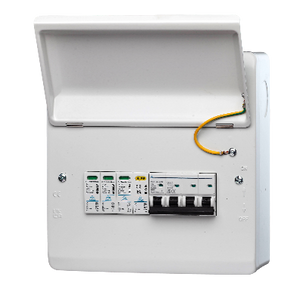
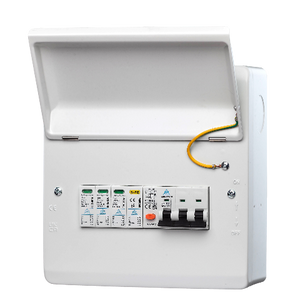
RCBO + Surge Protection – Fitted Consumer Unit IP40 – 3 Phase
Regular price From £65.00Regular price -


3-Phase PME PEN Fault Protection – 40A RCBO + Surge | Single EV Charger | BS7671 Compliant
Regular price From £65.00Regular price -
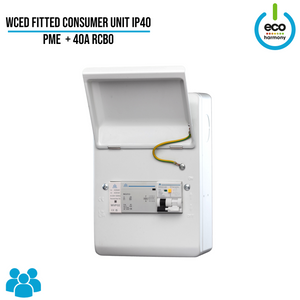
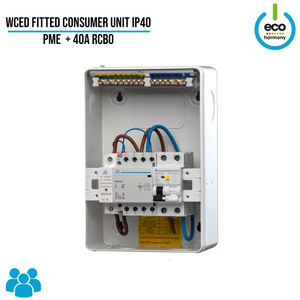
Fitted Consumer Unit IP40 – PME + 40A RCBO (Surge Protection + kWh Meter + Load Balancing Options Available)
Regular price From £80.00Regular price -
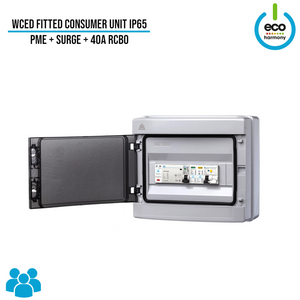
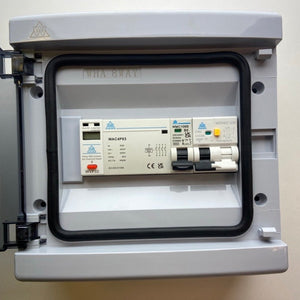
PEN Fault Detection + Surge Protection Device
Regular price From £77.50Regular price -
Save £2.50
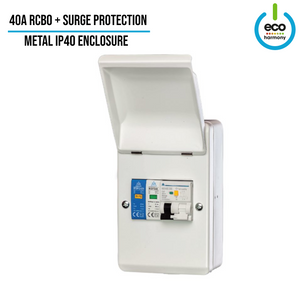
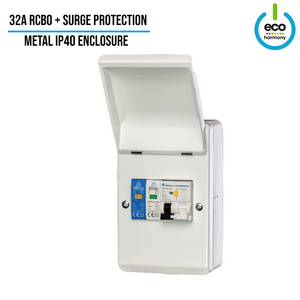
RCBO + Surge Protection Fitted Consumer Unit (IP30 / Indoor Use)
Regular price £32.50Regular price£35.00-£2.50 Sale price £32.50 -
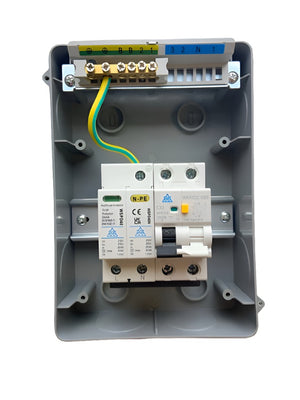
IP65 Consumer Unit with RCBO + Type 2 Surge Protection
Regular price £33.50Regular price£26.00Sale price £33.50


-


Simpson & Partners Cable Hook – Keep Your Charger Tidy & Stylish
Regular price £60.00Regular price -
Save £30.00


Home Series 7kW EV Charger – Type 2 Socket
Regular price From £550.00Regular price£580.00-£30.00 Sale price From £550.00 -


Home Series 7 kW Home EV Charger, Type 2 Tethered
Regular price From £620.00Regular price -


Free Colour Sample Card – Simpson & Partners EV Chargers
Regular price £0.00Regular price -
Sold out


Simpson & Partners Wireless Energy Manager – Smarter, Safer Charging
Regular price From £95.00Regular price


