
Do I Need an Earth Rod for EV Charger UK? (2026 Rules Explained)
Do I Need an Earth Rod for My EV Charger?
An earth rod is one valid way to deal with the PME/PEN fault risk on an EV charging circuit. It is rarely the simplest one. Here is how to work out whether you actually need one.
Quick answer
Usually no. For most UK homes, a charger with built-in open-PEN protection or an external PEN fault detection unit does the job without groundworks. An earth rod (TT) is worth considering only where the ground conditions suit it and you specifically want the installation electrically independent of the PME earth. See What is PME in EV charging? for the full background on why this decision exists at all.
When you probably don't need one
If any of the following apply, an earth rod is very unlikely to be the right call:
- The charger has built-in open-PEN protection (check the installation manual specifically for this, not just "RCD protection")
- You're fitting an external PEN fault detection unit upstream of the charger
- The property is on a TT or TN-S supply already (no shared PEN conductor to worry about)
- Ground conditions are poor: shallow rock, very dry or sandy soil, or a small garden with no suitable run for the electrode
In practice, this covers the large majority of UK domestic installs. The charger-with-built-in-protection and external-PEN-fault-unit routes are both simpler to install, simpler to certify, and don't depend on the ground cooperating.
When an earth rod is worth considering
An earth rod becomes a reasonable option when:
- the charger has no built-in protection and you'd rather not add an external device
- you have good, consistently damp ground near the installation point, which tends to give lower, more stable electrode resistance
- the installation is part of a wider project where groundworks are already happening (e.g. a new driveway)
- you want the charging circuit run as TT, electrically independent of the property's PME earth, for its own sake
The circuit is then typically run as TT: a dedicated electrode provides the earth for that circuit, kept separate from the main PME earth.
The resistance requirement is the real constraint
The practical difficulty with the earth rod route isn't the installation itself, it's achieving a low enough electrode resistance reliably. The required value depends on the protective device disconnection time and rating in use on that circuit, calculated in line with BS 7671's requirements for TT systems, and it has to be measured and recorded, not assumed.
Resistance depends heavily on soil type and moisture: wet clay gives good results, dry sand or shallow rock often doesn't. A single rod sometimes isn't enough and multiple rods bonded together may be needed, which adds cost and groundwork before you even know it will pass.
Earth rod vs PEN fault detection: the practical comparison
| Earth rod (TT) | PEN fault detection unit | |
|---|---|---|
| Groundworks required | Yes | No |
| Depends on ground conditions | Yes, can fail to achieve required resistance | No |
| Ongoing testing | Periodic resistance testing | Periodic function test (simulator or manufacturer procedure) |
| Typical cost driver | Groundworks and potentially multiple rods | The unit itself, a one-off component cost |
| Good fit for | Sites with naturally good ground and groundworks already planned | Most standard retrofits and new installs |
Frequently asked questions
Can I just not bother with either option?
No. On a PME supply, BS 7671 Regulation 722.411.4.1 restricts relying on the PME earth alone for outdoor EV charging, so one of the recognised routes has to be used. Leaving it unaddressed is not a compliant option.
How deep does an earth rod need to be driven?
Depth depends on achieving the required resistance value, not a fixed figure, so it varies by site and soil. An electrician will drive and test as they go, sometimes adding extension rods or additional electrodes if the first doesn't achieve a low enough reading.
Is a PEN fault detection unit a permanent fix, or does it need maintaining?
It needs periodic function testing, same principle as testing an RCD, rather than being fit-and-forget. The manufacturer's documentation sets the test interval and method.
Related guides
Not sure what your install needs?
Use the Product Finder →-
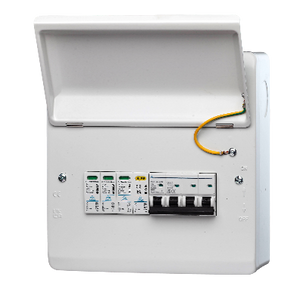
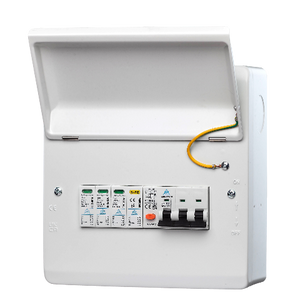
RCBO + Surge Protection – Fitted Consumer Unit IP40 – 3 Phase
Regular price From £65.00Regular price -


3-Phase PME PEN Fault Protection – 40A RCBO + Surge | Single EV Charger | BS7671 Compliant
Regular price From £65.00Regular price -
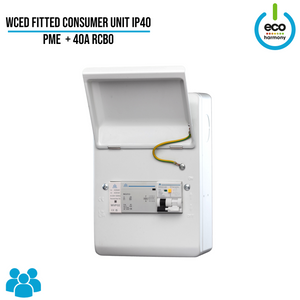
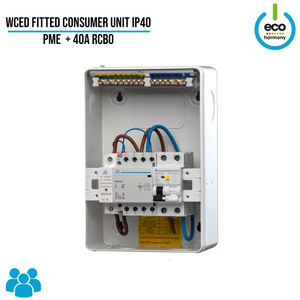
Fitted Consumer Unit IP40 – PME + 40A RCBO (Surge Protection + kWh Meter + Load Balancing Options Available)
Regular price From £80.00Regular price -
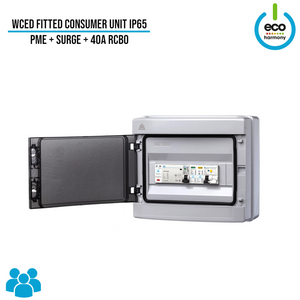
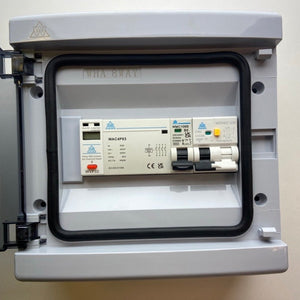
PEN Fault Detection + Surge Protection Device
Regular price From £77.50Regular price -
Save £2.50
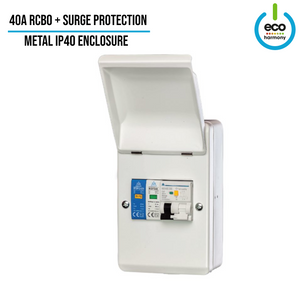
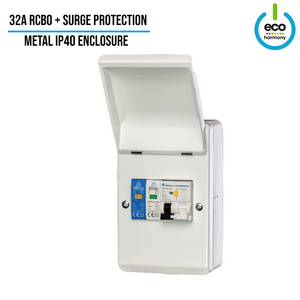
RCBO + Surge Protection Fitted Consumer Unit (IP30 / Indoor Use)
Regular price £32.50Regular price£35.00-£2.50 Sale price £32.50 -
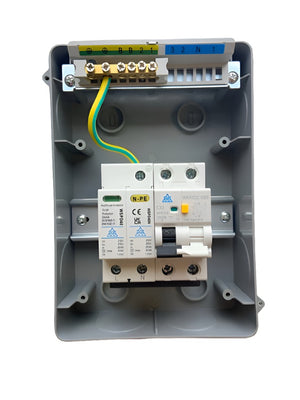
IP65 Consumer Unit with RCBO + Type 2 Surge Protection
Regular price £29.50Regular price


-


Simpson & Partners Cable Hook – Keep Your Charger Tidy & Stylish
Regular price £60.00Regular price -
Save £30.00


Home Series 7kW EV Charger – Type 2 Socket
Regular price From £550.00Regular price£580.00-£30.00 Sale price From £550.00 -


Home Series 7 kW Home EV Charger, Type 2 Tethered
Regular price From £620.00Regular price -


Free Colour Sample Card – Simpson & Partners EV Chargers
Regular price £0.00Regular price -
Sold out


Simpson & Partners Wireless Energy Manager – Smarter, Safer Charging
Regular price From £95.00Regular price


