3-Phase EV Charger RCBO & SPD Requirements UK | Guide

⚡ 3-Phase EV Charging · RCBO · SPD · Multi-Charger

3-Phase EV Charger RCBO, SPD & Multi-Charger Installs UK

Three-phase EV charging isn’t just faster — it requires different protection from a single-phase install. The RCBO specification changes, the SPD has to be rated for three-phase, and multi-charger sites introduce load sharing and circuit protection complexity that single-charger guides don’t cover. This one does.

Covers: 11kW & 22kW installs · RCBO & SPD specification · 2, 4 and 6+ charger sites · PME & non-PME supplies
🧠Expert technical advice since 2012 💷Competitive trade prices 📦Volume & OEM discounts 🚚Fast UK dispatch
Shop 3-Phase Boards →
Direct Answer

A 3-phase EV charger requires a 3-phase RCBO (or three individual single-pole RCBOs with a 4-pole isolator), a 3-phase Type 2 SPD, and on PME supplies, 3-phase PEN fault detection. For multi-charger sites, each charger circuit gets its own RCBO but shares a single PME protection board and SPD. EcoHarmony stocks fully assembled boards for both single and multiple 3-phase charger installs.

3-phase RCBO specification Type 2 SPD for 3-phase PME protection on 3-phase 2, 4 & 6+ charger layouts Pre-assembled boards available
🏠 Plain English — How is 3-phase protection different?

On a single-phase install, all the current flows through one live conductor and returns on the neutral. Protection devices — the RCBO, the SPD, the PME sensor — are monitoring that one path.

On a three-phase install, current is distributed across three live conductors simultaneously. A protection device that only monitors one phase is blind to faults on the other two. So every protection device — the RCBO, the SPD, the PEN fault detection — needs to be specified and rated for three-phase operation.

This is why you can’t take a single-phase WCED board and use it on a three-phase install. The products are different, even if they look similar.

RCBO Requirements for 3-Phase EV Chargers

Under BS 7671 Section 722, EV charger circuits require a minimum of a Type A RCBO for EV charger protection. For 3-phase installs:

🔄

Type A RCBO minimum

Type A detects AC and pulsating DC residual current. This is the minimum for EV circuits. Where the charger has a built-in DC detection mechanism (many modern 3-phase chargers do), Type A is generally acceptable.

Rating: typically 40A

A 22kW three-phase charger draws up to 32A per phase. A 40A RCBO provides the standard overcurrent protection with appropriate headroom. Circuit cable must be sized to match.

🔧

3-pole or three 1-pole?

Three-phase RCBOs can be specified as a single 3-pole device, or as three coordinated single-pole devices with a 4-pole isolator. EcoHarmony’s assembled boards handle this as a tested combination — no separate specification needed.

🛡️

RDC-DD consideration

Where the 3-phase charger does not have internal DC fault detection, a separate RDC-DD (6mA DC sensor) may be required in addition to the Type A RCBO. Check the charger manufacturer’s documentation.

SPD Requirements for 3-Phase EV Chargers

A Type 2 SPD is required for EV charger installations under BS 7671 Appendix 16 — the risk assessment for outdoor and semi-exposed installations almost always determines one is needed.

For three-phase installs, the SPD must be:

  • Three-phase rated — protecting all three live conductors, neutral, and earth
  • Type 2 — installed at the point of supply to the charger circuit, providing protection against transient overvoltages
  • Correctly connected — to all three phases plus neutral and PE in a TN system

A single-phase SPD on a three-phase install only protects one phase. The other two phases and the inter-phase voltage remain unprotected. All EcoHarmony 3-phase WCED boards include a correctly specified and pre-wired 3-phase Type 2 SPD.

PME Protection on 3-Phase Installs

If the property has a PME (TN-C-S) supply, PEN fault detection is required under BS 7671 Regulation 722.411.4.1 — regardless of whether the supply to the charger is single or three-phase.

For 3-phase installs on PME supplies, the PEN fault detection must be three-phase rated. It needs to monitor all three phases simultaneously. A device that only monitors one phase of a three-phase supply will miss PEN faults on the other two phases.

Non-PME supply (TN-S or TT)

PEN fault detection is not required. A 3-phase RCBO + SPD board covers all requirements. The WCED 3-Phase Consumer Unit with RCBO & SPD (IP40) at £79 is the correct product.

PME supply (TN-C-S) — most UK properties

PEN fault detection required. Must be 3-phase rated. The Tesla 3-Phase PME boards (£85 single charger, £185 multi-charger) include 3-phase PME protection.

Products for 3-Phase EV Charger Installs

Non-PME supply · Single 3-phase charger · £79

WCED 3-Phase Consumer Unit — RCBO & SPD (IP40)

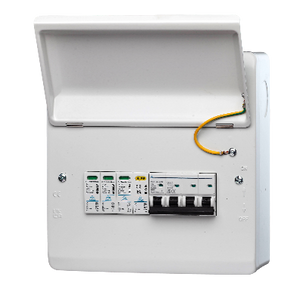
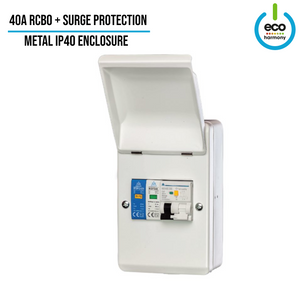
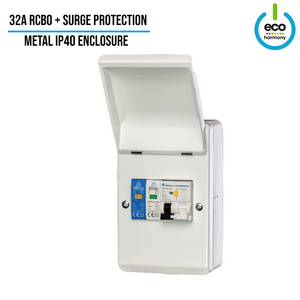
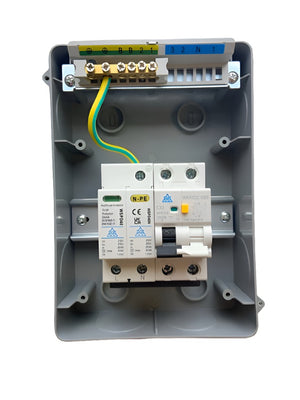
IP40 metal enclosure. 3-phase RCBO + Type 2 SPD. Pre-assembled, ready to install. For 3-phase EV charger installs where the property is on a TN-S or TT supply (no PME protection required). Also suitable for second sub-distribution downstream of an existing PME board.

  • 3-phase RCBO protection
  • Type 2 SPD — 3-phase rated
  • IP40 metal enclosure
  • No PME protection (non-PME supply use)
Buy — £79.00 →
PME supply · Single 3-phase charger · £85

3-Phase PME Board — Single Charger (IP40)

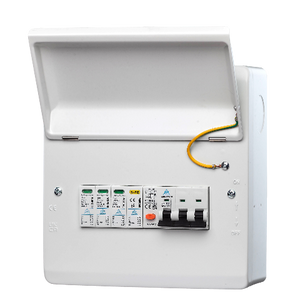
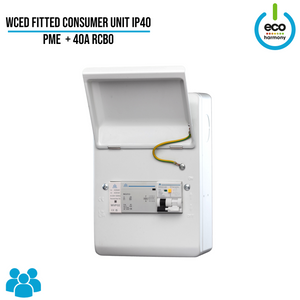
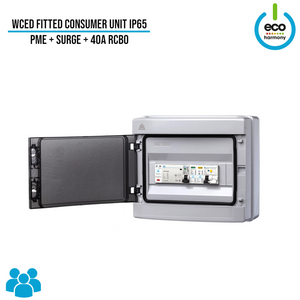
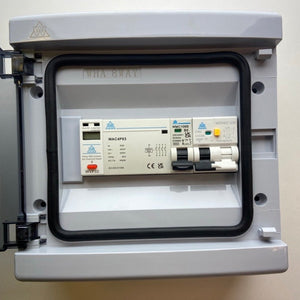
IP40 metal enclosure. 3-phase PEN fault detection + 40A RCBO + Type 2 SPD. The complete solution for a single 3-phase EV charger on a UK PME supply. Pre-assembled and tested.

  • 3-phase PME/PEN fault detection
  • 40A RCBO protection
  • Type 2 SPD included
  • IP40 metal enclosure
Buy — £85.00 →
PME supply · Multiple 3-phase chargers · £185

3-Phase PME Board — Multi-Charger (IP40)

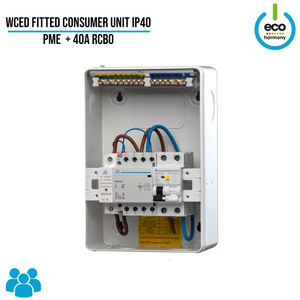
IP40 metal enclosure. 3-phase PEN fault detection + multiple 40A RCBOs + Type 2 SPD in a larger board for multi-charger installations. Most cost-effective solution for 2–4 three-phase chargers on a single PME supply. Each charger circuit gets its own RCBO; PME protection and SPD are shared.

  • 3-phase PME/PEN fault detection (shared)
  • Individual 40A RCBO per charger circuit
  • Type 2 SPD (shared)
  • IP40 metal enclosure
  • Covers 2–4 charger circuits
Buy — £185.00 →

Multi-Charger Site Design — How Protection is Shared

On a multi-charger site, not every device needs to be duplicated for every charger. The protection architecture is:

Protection layer Per charger or shared? Notes
PEN fault detection (PME) Shared — one device per site supply Monitors the incoming PME supply, not individual circuits
SPD (surge protection) Shared — one device per distribution point Protects all downstream circuits from the same point
RCBO Per charger circuit Each charger circuit must have its own overcurrent and residual current protection
Isolation (main switch) Shared — per distribution board Allows all circuits to be isolated from a single point for maintenance

This architecture explains why the multi-charger PME board (£185) is significantly more cost-effective than fitting two separate single-charger PME boards (2 × £85 = £170 just for boards, not counting additional installation time).

Above 4 Chargers — When a TPN Distribution Board Makes More Sense

For sites with 5 or more three-phase chargers, the multi-charger PME board approach reaches its practical limit. At this point, a TPN distribution board with a main PME protection device upstream becomes the more appropriate solution. See the commercial distribution board guide for detail on this approach.

Load Sharing Across Multiple Chargers

Protection and load sharing are separate issues but both matter for multi-charger sites.

Static load limiting

The supply capacity is divided equally between chargers regardless of whether they’re in use. Simple to implement at the wiring stage — each circuit is rated at a fraction of total available supply.

🔄

Dynamic load balancing

A CT clamp measures total site consumption and each charger adjusts its draw dynamically. Allows fuller use of available supply capacity. Requires chargers with load balancing capability and a compatible CT clamp installation.

🚗

Charger-to-charger sharing (e.g. Tesla Power Share)

Some charger brands (Tesla, Simpson & Partners) allow chargers to communicate and share available current without external CT clamps. The protection board design is unchanged; this is a charger software feature.

Frequently Asked Questions

Can I use a single-phase WCED board for a 3-phase charger install?
No. A single-phase board only provides RCBO and SPD protection on one phase, and PEN fault detection on a single-phase supply. A 3-phase charger draws current across three phases, and all three need protection. Using a single-phase board on a 3-phase install is not compliant with BS 7671 and is not safe practice.
Do all 3-phase charger circuits need their own RCBO?
Yes. Each charger circuit requires its own RCBO for overcurrent and residual current protection. The PME protection device and SPD can be shared across chargers (they protect the supply, not individual circuits), but the RCBO must be per circuit.
What RCBO rating do I need for a 22kW three-phase charger?
A 22kW charger draws approximately 32A per phase. A 40A RCBO is the standard specification, providing protection with appropriate headroom. Cable sizing must match — typically 6mm² four-core for a 22kW circuit, subject to installation method and cable run length.
My supply is TN-S (separate earth). Do I still need PME protection?
No. PME/PEN fault detection is only required on TN-C-S (PME) supplies where the neutral and earth are combined. On a TN-S supply with a separate earth, PEN faults cannot occur in the same way. You still need the RCBO and SPD — just not the PEN fault detection element. The WCED 3-Phase RCBO + SPD board at £79 is the appropriate product for TN-S three-phase installs.
How many chargers can the multi-charger PME board handle?
The EcoHarmony multi-charger 3-phase PME board (£185) is designed for 2–4 three-phase charger circuits. For larger sites with 5+ chargers, a TPN distribution board with upstream PME protection is the recommended approach.
Is an IP65 board required for outdoor 3-phase charger installs?
It depends on the mounting location. If the board is mounted outside, directly exposed to weather, an IP65 weatherproof enclosure is required. If it’s mounted inside a garage, plant room, or other sheltered location, an IP40 metal enclosure is generally adequate. EcoHarmony stocks both IP40 and IP65 options.

EcoHarmony — 3-phase protection boards UK-stocked

We stock the full range of 3-phase WCED boards — from the basic RCBO + SPD board for TN-S installs through to the multi-charger PME board for complex sites. All pre-assembled, tested, and ready to install. Volume pricing for regular installers.

  • 🧠 Technical advice on board selection for your specific supply and site
  • 💷 Trade pricing — volume discounts from 5+ units
  • 📦 OEM pricing for installers running regular commercial programmes
  • 🚚 Same-day dispatch on all stock lines

Specifying for a 3-phase or multi-charger install?

Tell us your supply type, number of chargers, and mounting location — we’ll confirm the right board.

Technical Glossary

Three-phase supply
Electrical supply with three live conductors at 400V between phases. Enables up to 22kW EV charging vs 7.4kW on single-phase. Available at some domestic and most commercial UK properties.
RCBO
Residual Current Breaker with Overcurrent — combines RCD and MCB protection. Type A minimum for EV charger circuits. One required per charger circuit on a multi-charger install.
Type 2 SPD
Surge Protection Device installed at the distribution board to protect downstream circuits from transient overvoltages. Must be 3-phase rated on 3-phase installations. Can be shared across multiple charger circuits from the same distribution point.
PEN fault detection
Monitors the PME supply for a break or high resistance in the combined neutral/earth conductor. Automatically disconnects the circuit if a fault is detected. Must be 3-phase rated on 3-phase PME installs.
TPN
Three-Pole and Neutral — distribution board or isolator handling three-phase and neutral. Used in larger multi-charger commercial installations for sub-mains distribution.
RDC-DD
Residual Direct Current Detector — detects smooth DC residual current (6mA threshold) that a Type A RCD cannot. Required where the 3-phase charger does not have built-in DC fault detection.
Load balancing
Dynamic adjustment of charge rate per circuit based on total site demand. A software/hardware feature of the charger system, separate from the protection board.
3-phase EV charger protection boards Single & multi-charger · PME & non-PME · From £79