
Electrical Safety Knowledge Base | Wiring Protection Explained | EcoHarmony
Electrical Safety Knowledge Base
Plain-English guides to electrical protection for UK installers and homeowners: earthing, RCDs and RCBOs, surge protection, distribution boards and heat pumps, written to BS 7671 and linked to the products they cover.
Start here
No single device gives complete protection. Good design layers earthing, residual current protection, overcurrent protection and surge protection, each doing a different job. Start with the topic that matches your job below, or use the Product Finder if you know the job but not the product.
PME & Earthing
How UK supplies are earthed, what a PEN fault is, and the three ways to protect an EV charger on a PME supply.
What Is PME in EV Charging?
PME, PEN faults, BS 7671 and your three compliance options.
Read the guide →Do I Need an Earth Rod?
When a TT earth electrode is worth it, and when it isn't.
Read the guide →PME Protection Devices
Choosing a PEN fault unit: phase, IP rating, RCBO and surge options.
Read the guide →Tesla Installs on PME
What is specific to a Tesla Wall Connector on a PME supply.
Read the guide →PME & PEN Fault FAQs
Fast answers to the most common questions.
Read the guide →Expert Q&A
Edge cases from real installer support conversations.
Read the guide →
Shop:PME protection units
RCDs, RCBOs & AFDDs
What each protective device does, which type and sensitivity to specify, and how to coordinate them.
RCBO vs MCB vs RCD
What each device protects against, and why RCBOs are standard.
Read the guide →RCBO Types: A, B, F and AFDD
What the type letter means and where each is needed.
Read the guide →What Is a Type B RCD?
DC leakage and why some EV chargers need extra protection.
Read the guide →RCD Trip Sensitivity
30mA, 100mA and 300mA, and how they work together.
Read the guide →Time Delay RCDs
S-type devices for discrimination in layered systems.
Read the guide →4-Pole vs 2-Pole RCDs
Pole count for single-phase and three-phase circuits.
Read the guide →Arc Fault Detection (AFDD)
What AFDDs detect that MCBs and RCDs cannot.
Read the guide →EV Charger Keeps Tripping?
Causes of repeated RCD trips and what to do.
Read the guide →
Surge Protection
When SPDs are needed, which type goes where, and how to install and specify them for EV, solar and heat pump circuits.
Do I Need Surge Protection?
The BS 7671 risk assessment in plain English.
Read the guide →Type 1 vs Type 2 vs Type 1+2
Which SPD category suits which installation.
Read the guide →How to Install an SPD
Lead lengths, earthing and common mistakes.
Read the guide →SPD kA Ratings Explained
What 40kA means and how to read a datasheet.
Read the guide →Surge Protection for EV Chargers
Where the SPD goes on a charging circuit.
Read the guide →Solar and Heat Pumps
AC and DC protection for PV and heat pump circuits.
Read the guide →DC Surge Protection (1000V)
How DC SPDs differ and where to fit them.
Read the guide →
Shop:Surge protection
Distribution Boards & Enclosures
Boards, consumer units and enclosures for single-phase, three-phase and multi-charger installs.
TPN 3-Phase Distribution Boards
Sizing and specifying boards for 11-22kW charging.
Read the guide →3-Phase and Multi-Charger Installs
Per-charger and shared protection for multi-bay sites.
Read the guide →Fully Assembled Consumer Units
Why pre-wired boards save time and reduce errors.
Read the guide →IP40 vs IP65 Enclosures
Indoor and outdoor ratings and when each is required.
Read the guide →Metal vs Plastic Enclosures
Practical differences in fire rating, fixing and use.
Read the guide →Modular Contactors
What DIN-rail contactors do in EV and load switching.
Read the guide →Solar Combiner Boxes
PV string combiner boxes with DC protection.
Read the guide →
Heat Pumps
Electrical protection requirements for heat pump circuits and how to work out who to call when one trips.
Common questions about electrical protection
What is the difference between an MCB, RCD and RCBO?
An MCB protects against overload and short circuit. An RCD detects earth leakage but has no overcurrent protection. An RCBO combines both in one device and is the standard for individual circuits.
When is surge protection needed?
BS 7671 requires protection against transient overvoltages to be assessed on every installation. In practice a Type 2 SPD is specified as standard on new and replacement consumer units, and on circuits supplying EV chargers, solar inverters and heat pumps.
What type of RCD does an EV charger need?
It depends on whether the charger has its own DC leakage detection. Chargers with it can normally use a Type A device upstream. Without it, a Type B device is needed. Always check the charger’s installation manual.
Do I need an AFDD?
Amendment 2 of BS 7671 addresses AFDDs for higher-risk situations such as buildings with sleeping accommodation. Whether they are required or recommended depends on the building type and the current wording, so check the regulation in force and see our arc fault detection guide.
What is the difference between IP40 and IP65?
IP40 protects against solid objects over 1mm and gives no water protection, so it suits dry indoor locations. IP65 is dust-tight and protected against water jets, and is needed outdoors or where moisture may be present.
More from EcoHarmony
-
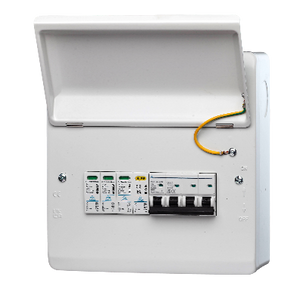
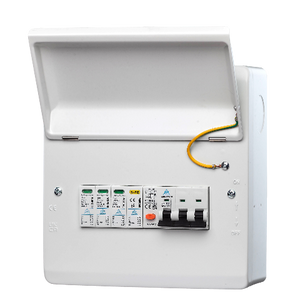
RCBO + Surge Protection – Fitted Consumer Unit IP40 – 3 Phase
Regular price From £65.00Regular price -


3-Phase PME PEN Fault Protection – 40A RCBO + Surge | Single EV Charger | BS7671 Compliant
Regular price From £65.00Regular price -
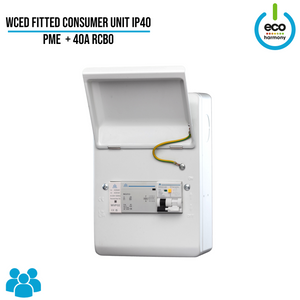
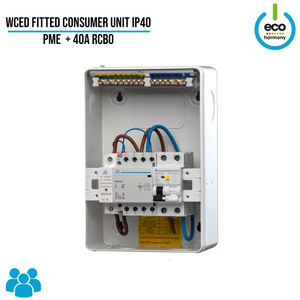
Fitted Consumer Unit IP40 – PME + 40A RCBO (Surge Protection + kWh Meter + Load Balancing Options Available)
Regular price From £80.00Regular price -
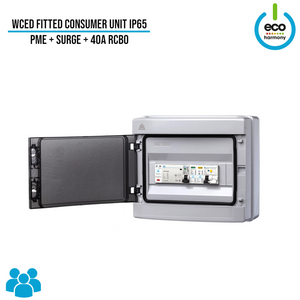
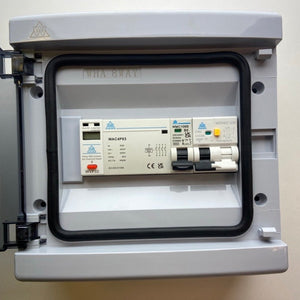
PEN Fault Detection + Surge Protection Device
Regular price From £77.50Regular price -
Save £2.50
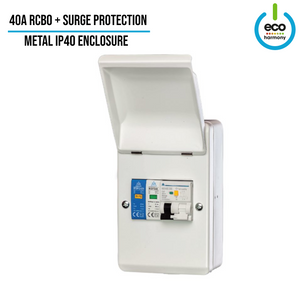
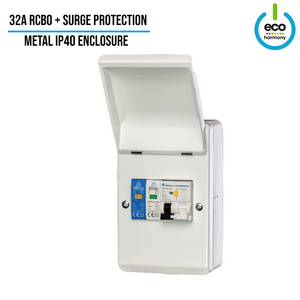
RCBO + Surge Protection Fitted Consumer Unit (IP30 / Indoor Use)
Regular price £32.50Regular price£35.00-£2.50 Sale price £32.50 -
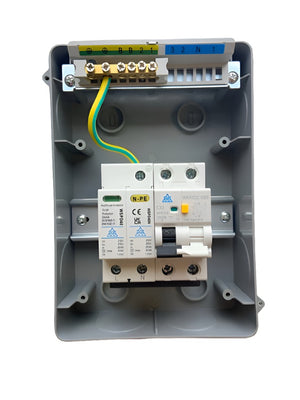
IP65 Consumer Unit with RCBO + Type 2 Surge Protection
Regular price £33.50Regular price£26.00Sale price £33.50


-


Simpson & Partners Cable Hook – Keep Your Charger Tidy & Stylish
Regular price £60.00Regular price -
Save £30.00


Home Series 7kW EV Charger – Type 2 Socket
Regular price From £550.00Regular price£580.00-£30.00 Sale price From £550.00 -


Home Series 7 kW Home EV Charger, Type 2 Tethered
Regular price From £620.00Regular price -


Free Colour Sample Card – Simpson & Partners EV Chargers
Regular price £0.00Regular price -
Sold out


Simpson & Partners Wireless Energy Manager – Smarter, Safer Charging
Regular price From £95.00Regular price


