
Do I Need Surge Protection? 18th Edition BS 7671 Guide
Do I Need Surge Protection? 18th Edition BS 7671 Guide
BS 7671 makes you consider protection against transient overvoltages on every installation. For almost every modern home or commercial site, that assessment ends the same way: fit an SPD.
Quick answer
Under BS 7671:2018+A2:2022, protection against transient overvoltages has to be considered on every installation. In practice the answer is almost always yes: an SPD costs little compared with the equipment it protects.
What BS 7671 says
Section 443 of BS 7671:2018+A2:2022 deals with protection against transient overvoltages. The assessment looks at the consequences of equipment failure, the overvoltage category of the equipment, the lightning flash density at the location, and whether the supply is overhead or underground.
Where the consequences of a surge would be unacceptable, an SPD is needed. For most homes and commercial sites that means damage to electronics, appliances or safety-critical equipment, so the cases where an SPD can genuinely be left out are narrow.
The risk assessment in practice
| Factor | Lower risk | Higher risk: SPD strongly indicated |
|---|---|---|
| Supply type | Underground cable throughout | Overhead supply lines (rural, older networks) |
| Location | Urban area, low lightning flash density | Rural, elevated or exposed location |
| Equipment at risk | Minimal electronics | EV charger, solar inverter, heat pump, smart home equipment, computers |
| Consequence of failure | Low: easy to replace, no safety risk | High: expensive equipment, safety-critical systems, data loss |
| Building type | Simple residential, no special requirements | New build, HMO, commercial |
Applied honestly, virtually every modern home or commercial site meets the criteria. A house with an EV charger, solar inverter, smart meter, computers and a connected heating system has equipment that is both expensive and sensitive to surges. An SPD is a small cost against replacing even one protected item.
New builds and Building Regulations
Electrical work in new dwellings has to meet BS 7671, so the surge protection assessment above applies to new builds and major rewires. Scotland, Wales and Northern Ireland have separate regulations, but the direction is the same: installers everywhere should specify SPDs as standard on new and replacement consumer units.
Where is an SPD installed?
A Type 2 SPD goes in or right beside the consumer unit, connected between the incoming live conductors and earth. The WCED WSPD range includes plug-in modules (WSPDT2-CB) and standalone units (WSPD240, WSPD440) that fit alongside the main switch and MCBs or RCBOs. For connection methods and cable lengths, see how to install an SPD.
Frequently asked questions
Can I leave out a surge protection device if the customer doesn’t want one?
You can document a risk assessment that concludes an SPD isn’t needed, but that is increasingly hard to justify for any installation with electronics. The installer carries responsibility for the assessment. If a customer declines an SPD the assessment says is needed, record it and have the customer sign to confirm.
Does an SPD need its own OCPD (fuse or MCB)?
Yes. Most manufacturers specify a fuse or MCB on the supply side of the SPD, typically 63A, to protect the SPD supply cable if the SPD fails. The WSPDT2-CB includes a pre-fitted cable set and connection details.
Does a surge protector power strip replace a properly installed SPD?
No. Plug-in strips are Type 3 devices that deal with residual surge energy left over from a Type 2 device upstream. Use them in addition to a Type 2 at the consumer unit, not instead of one. Without a Type 2 upstream, a strip can be overwhelmed by a large surge.
Related guides
Not sure what your install needs?
Use the Product Finder →-
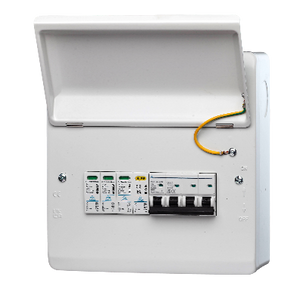
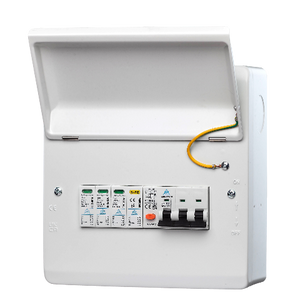
RCBO + Surge Protection – Fitted Consumer Unit IP40 – 3 Phase
Regular price From £65.00Regular price -


3-Phase PME PEN Fault Protection – 40A RCBO + Surge | Single EV Charger | BS7671 Compliant
Regular price From £65.00Regular price -
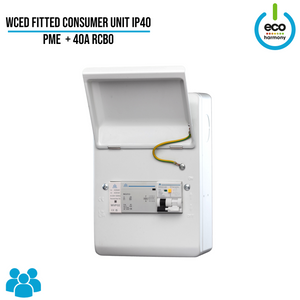
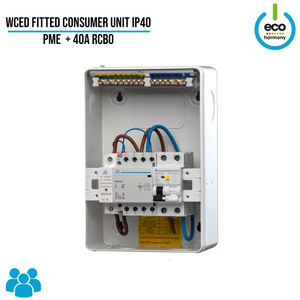
Fitted Consumer Unit IP40 – PME + 40A RCBO (Surge Protection + kWh Meter + Load Balancing Options Available)
Regular price From £80.00Regular price -
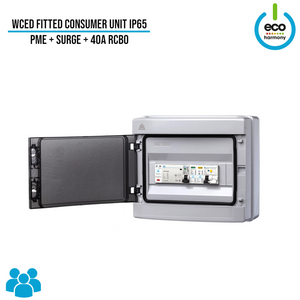
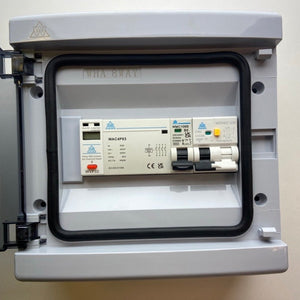
PEN Fault Detection + Surge Protection Device
Regular price From £77.50Regular price -
Save £2.50
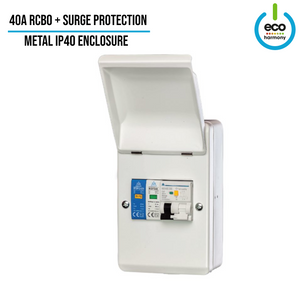
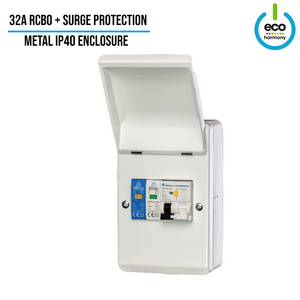
RCBO + Surge Protection Fitted Consumer Unit (IP30 / Indoor Use)
Regular price £32.50Regular price£35.00-£2.50 Sale price £32.50 -
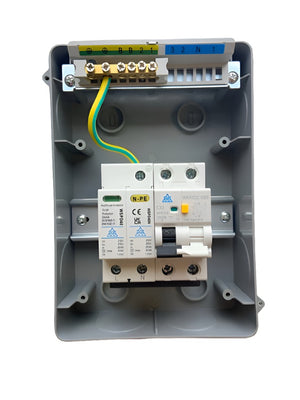
IP65 Consumer Unit with RCBO + Type 2 Surge Protection
Regular price £33.50Regular price£26.00Sale price £33.50


-


Simpson & Partners Cable Hook – Keep Your Charger Tidy & Stylish
Regular price £60.00Regular price -
Save £30.00


Home Series 7kW EV Charger – Type 2 Socket
Regular price From £550.00Regular price£580.00-£30.00 Sale price From £550.00 -


Home Series 7 kW Home EV Charger, Type 2 Tethered
Regular price From £620.00Regular price -


Free Colour Sample Card – Simpson & Partners EV Chargers
Regular price £0.00Regular price -
Sold out


Simpson & Partners Wireless Energy Manager – Smarter, Safer Charging
Regular price From £95.00Regular price


