Tesla EV Charger Installation UK — PME Protection Guide
Tesla EV Charger Installation UK — PME Protection Explained
Installing a Tesla Wall Connector in the UK involves exactly the same PME protection requirements as any other EV charger. But 3-phase installs — which Tesla increasingly uses for faster charging — add a layer of complexity most guides skip over entirely. This one doesn’t.
A Tesla Wall Connector on a UK PME (TN-C-S) supply requires PEN fault detection — exactly like any other EV charger. On a single-phase supply, a standard single-phase WCED board covers this. On a 3-phase supply, you need a 3-phase PME board specifically rated for 3-phase use. EcoHarmony stocks both — including Tesla-specific 3-phase boards for single and multiple Wall Connector installs.
No and yes. A Tesla Wall Connector isn’t a special case under UK electrical regulations — it’s an EV charger like any other, and the same rules apply. What makes Tesla installs feel different is that a significant proportion of them use a 3-phase supply, which changes the protection requirements compared to a standard single-phase domestic install.
If your property has a 3-phase supply and you want faster charging (up to 22kW vs 7kW on single-phase), the protection board needs to be rated for 3-phase. Many installers try to fit a single-phase PME board on a 3-phase install — this doesn’t meet the regulations and isn’t safe. The boards are different products.
What Is a Tesla Wall Connector?
The Tesla Wall Connector is Tesla’s own home and commercial EV charger, available in Gen 2 and Gen 3 versions. Key facts for UK installers:
Charging speed
Up to 7.4kW on single-phase (32A), up to 22kW on three-phase (32A per phase). The Wall Connector auto-detects the supply and adjusts accordingly.
Connector type
Gen 3 uses a proprietary Tesla connector for Tesla vehicles only. Requires a Type 2 adapter or separate Type 2 charger for non-Tesla EVs.
Smart features
App control, scheduling, Powerwall integration, load balancing (when multiple Wall Connectors are daisy-chained). Requires WiFi connection.
UK compliance
OZEV approved. Requires BS 7671 Section 722 compliant installation — including appropriate PME protection on TN-C-S supplies.
PME Protection for Tesla Installs — Why It’s Required
Approximately 80% of UK homes are on a PME (TN-C-S) supply — where the neutral and earth conductors are combined in the supply cable. Under BS 7671 Regulation 722.411.4.1, any EV charger on a PME supply must have automatic disconnection if a PEN fault occurs.
A PEN fault — a break in the combined neutral/earth conductor upstream — can raise the exposed metalwork of the charger (and vehicle) to a dangerous voltage. Without PME protection, this fault goes undetected and creates a serious shock risk.
This applies to Tesla Wall Connectors exactly as it applies to every other EV charger brand
Tesla’s own installation documentation acknowledges the UK PME requirement. An install without appropriate PEN fault detection on a PME supply is not BS 7671 compliant and should not be signed off by a competent electrician.
Single-Phase Tesla Install on PME
Standard single-phase Wall Connector install (7.4kW, 32A) on a PME supply. Protection required:
- PEN fault detection device (in the WCED board)
- Type A RCBO minimum — 32A or 40A depending on cable sizing
- Type 2 surge protection device (SPD)
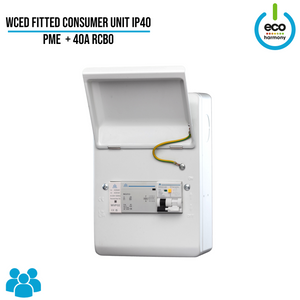
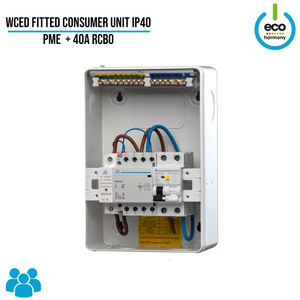
All three are combined in EcoHarmony’s single-phase WCED boards. No earth rod required.
Three-Phase Tesla Install on PME
Three-phase Wall Connector install (up to 22kW) on a PME supply. Protection required:
- 3-phase rated PEN fault detection (a single-phase device is not adequate)
- 40A RCBO per phase (or equivalent)
- Type 2 surge protection device
- 4-pole isolation where required
Critical distinction: A single-phase PME board on a 3-phase Tesla install does not provide adequate PEN fault detection across all three phases. A 3-phase-specific PME board is required.
Products for Tesla Wall Connector Installs
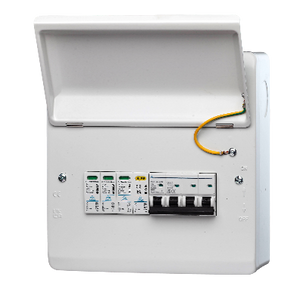
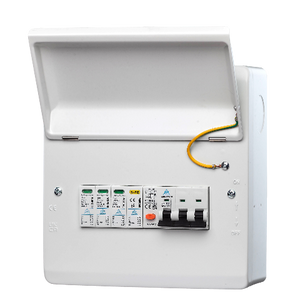
Tesla 3-Phase PME Board — Single Charger
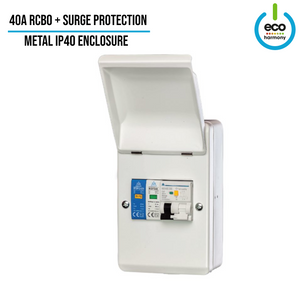
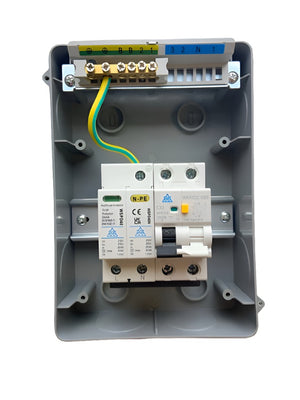
IP40 metal enclosure. PEN fault detection + 40A RCBO + Type 2 SPD. Sized and specified for a single Tesla Wall Connector (or any single 3-phase EV charger) on a UK PME supply. Pre-assembled, ready to install.
- PME/PEN fault detection — 3-phase rated
- 40A RCBO protection
- Type 2 SPD included
- IP40 metal enclosure
- BS 7671 Section 722 compliant
Tesla 3-Phase PME Board — Multiple Chargers
IP40 metal enclosure. PEN fault detection + multiple 40A RCBOs + SPD in a larger enclosure for multi-charger installs. Covers multiple Tesla Wall Connectors or mixed 3-phase EV chargers on a single PME-protected supply. Most cost-effective solution for 2+ charger sites.
- PME/PEN fault detection — 3-phase rated
- Multiple 40A RCBOs (for multiple charger circuits)
- Type 2 SPD included
- IP40 metal enclosure
- Covers 2+ Wall Connectors from one board
Single-Phase Tesla Installs
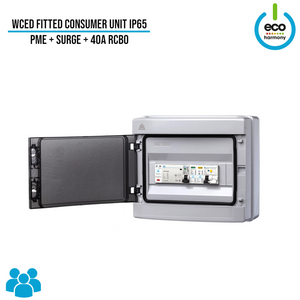
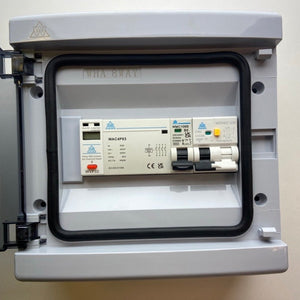
PME Consumer Unit IP65 — 40A RCBO + SPD
Weatherproof IP65 plastic enclosure. PEN fault detection + 40A RCBO + SPD. Best choice for an outdoor single-phase Tesla Wall Connector where the board is mounted externally or in an exposed location.
Buy — £68.25 →PME Consumer Unit IP40 — RCBO + SPD + Load Balance
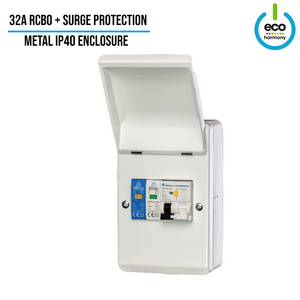
Metal IP40 enclosure. PEN fault detection + RCBO + SPD + load balancing relay. Best choice where the supply capacity needs managing — particularly where a heat pump, EV charger, and other high-draw loads share a limited supply.
Buy — £88.00 →Single-Phase vs Three-Phase Tesla Charging — Which to Install?
| Factor | Single-Phase (7.4kW) | Three-Phase (11–22kW) |
|---|---|---|
| Max charge rate | 7.4kW (32A) | Up to 22kW (32A per phase) |
| Miles added per hour | ~25–30 miles/hr | ~75–80 miles/hr at 22kW |
| Supply requirement | Standard single-phase domestic | 3-phase supply at the property |
| Install complexity | Standard domestic install | More complex — 3-phase protection required |
| PME board required | Standard single-phase WCED board | 3-phase PME board (different product) |
| Suitable for | Most homes, overnight charging | High mileage, commercial, properties with 3-phase |
For most UK homeowners: single-phase at 7.4kW is more than sufficient. A full charge from empty on a typical Tesla Model 3 (75kWh) takes around 10 hours overnight — plugged in every evening, the car is always full in the morning. Three-phase makes sense for high-mileage drivers, commercial contexts, or properties that already have a 3-phase supply.
Multi-Charger Tesla Installs — Houses & Commercial
Properties with multiple Tesla vehicles, or commercial locations with multiple charging bays, need a different approach to protection.
Two Tesla vehicles, one property
The most common multi-charger scenario. Two Wall Connectors can share a single 3-phase PME board — significantly cheaper than two separate boards. Tesla’s Power Sharing feature also allows the Wall Connectors to share available current automatically.
Small commercial sites
Offices, hospitality venues, car parks with 2–4 Tesla Wall Connectors. The multi-charger 3-phase PME board covers all circuits from a single point of protection. Above 4 chargers, a TPN distribution board becomes the more practical solution.
Mixed fleet (Tesla + other brands)
Where the site has Tesla Wall Connectors alongside other brand 3-phase chargers, the same 3-phase PME board covers all circuits. Protection requirements don’t change by charger brand.
Common Installation Questions — Tesla & PME
Does Tesla manufacture their own PME protection device?
Does the Tesla Wall Connector have built-in RCD protection?
Can I use a single-phase PME board for a 3-phase Tesla install?
What is Tesla Power Sharing and how does it affect protection?
Does Tesla Wall Connector need an SPD (surge protection device)?
What cable size do I need for a Tesla Wall Connector?
Is the Tesla Wall Connector OZEV approved?
My property has a 3-phase supply. Can I charge at 22kW?
Ready to specify protection for a Tesla install?
Single or multi-charger. Single or three-phase. We have the board for it.