
Time Delay RCDs Explained — When and Why to Use Them
Time Delay RCDs Explained: When and Why to Use Them
A time delay (S-type) RCD is deliberately slow to trip, so a downstream 30mA RCD operates first. That keeps a layered protection system selective: one circuit fault doesn’t disconnect the whole installation.
Quick answer
Use an S-type RCD upstream of instantaneous 30mA devices (TT systems, large boards, multi-occupancy buildings, EV distribution boards) so only the device closest to the fault trips.
What is an S-type (time delay) RCD?
In an installation with several layers of RCD protection, the devices have to be coordinated so a fault trips only the one nearest to it. This is selectivity, or discrimination. Time delay RCDs are how you achieve it.
An S-type RCD (S for Selective) has a built-in delay, typically 60 to 200 milliseconds, before it opens its contacts. That pause lets downstream instantaneous RCDs trip first and clear the fault before the upstream device operates.
Without the delay, both devices would try to trip at once. Whichever is marginally faster wins, and you have no reliable selectivity: a minor downstream fault could take out the whole upstream supply.
Where time delay RCDs are used
| Application | Upstream device | Downstream device | Why time delay is needed |
|---|---|---|---|
| TT earthing systems | 100mA or 300mA S-type | 30mA instantaneous RCBOs | Upstream must not trip when one 30mA circuit clears a fault |
| Large distribution boards | 300mA S-type at incomer | 30mA RCBOs on each circuit | Keeps supply to unaffected circuits during a fault |
| Multi-occupancy buildings | 100mA or 300mA S-type per floor or flat | 30mA RCBOs per circuit | A fault in one flat must not affect other occupants |
| EV charging distribution boards | 300mA S-type at supply incomer | 30mA or Type B RCDs per charger | One charger fault must not disconnect all chargers |
S-type vs G-type
| Designation | Delay | Application |
|---|---|---|
| S-type (Selective) | 60–200 ms | Upstream of instantaneous 30mA devices. The standard for discrimination. |
| G-type (short time delay) | 10–50 ms | Where a shorter delay is acceptable. Less common in UK domestic work. |
For UK domestic and commercial work, S-type is the standard. It is tested to BS EN 61008 and is designed not to trip too quickly at higher fault currents, giving downstream instantaneous devices time to clear first.
WCED time delay RCD range
The WCED WARTD series provides A-Type time delay RCDs in 2-pole and 4-pole versions, 63A to 100A, at 100mA sensitivity. They are specified upstream in TT systems and larger distribution boards where full discrimination across several downstream 30mA circuits is needed.
Frequently asked questions
Does a time delay RCD still provide protection?
Yes. It still trips on a fault; it just waits a short, defined time first. If the downstream device fails to clear the fault, the time delay device operates. The delay is short enough (typically under 200ms) that danger from a downstream fault stays minimal.
Can I use a time delay RCD in a domestic consumer unit?
Time delay devices normally sit upstream of a domestic consumer unit, for example as the incomer RCD in a TT system feeding a sub-board, or as a floor-level RCD in a multi-occupancy building. Inside a standard domestic consumer unit, instantaneous 30mA RCBOs on each circuit give the right protection without upstream time delay devices.
What is the difference between a time delay RCD and a high-sensitivity RCD?
They are independent characteristics. Sensitivity (30mA, 100mA, 300mA) sets the leakage current at which the device trips. Time delay (S-type, G-type) sets how quickly it trips once that threshold is reached. A time delay RCD is usually rated at 100mA or 300mA and used upstream, so the downstream 30mA device always operates first.
Related guides
Not sure what your install needs?
Use the Product Finder →-
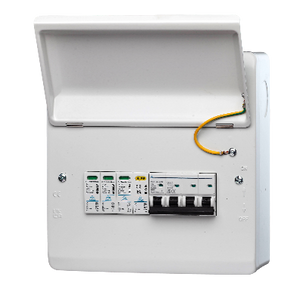
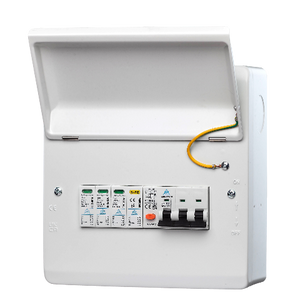
RCBO + Surge Protection – Fitted Consumer Unit IP40 – 3 Phase
Regular price From £65.00Regular price -


3-Phase PME PEN Fault Protection – 40A RCBO + Surge | Single EV Charger | BS7671 Compliant
Regular price From £65.00Regular price -
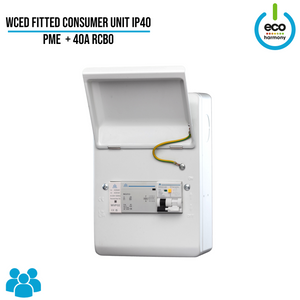
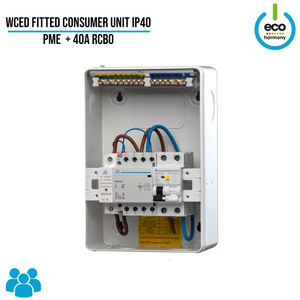
Fitted Consumer Unit IP40 – PME + 40A RCBO (Surge Protection + kWh Meter + Load Balancing Options Available)
Regular price From £80.00Regular price -
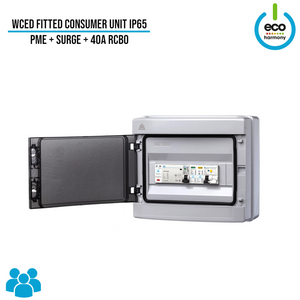
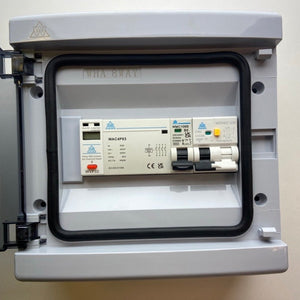
PEN Fault Detection + Surge Protection Device
Regular price From £77.50Regular price -
Save £2.50
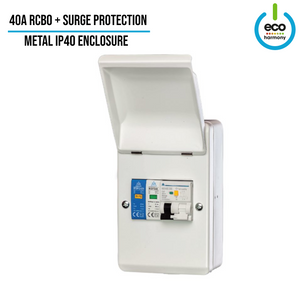
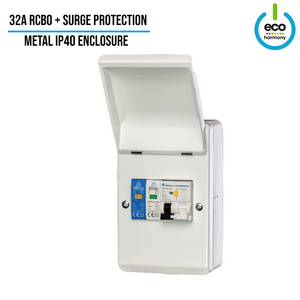
RCBO + Surge Protection Fitted Consumer Unit (IP30 / Indoor Use)
Regular price £32.50Regular price£35.00-£2.50 Sale price £32.50 -
IP65 Consumer Unit with RCBO + Type 2 Surge Protection
Regular price £33.50Regular price£26.00Sale price £33.50


-


Simpson & Partners Cable Hook – Keep Your Charger Tidy & Stylish
Regular price £60.00Regular price -
Save £30.00


Home Series 7kW EV Charger – Type 2 Socket
Regular price From £550.00Regular price£580.00-£30.00 Sale price From £550.00 -


Home Series 7 kW Home EV Charger, Type 2 Tethered
Regular price From £620.00Regular price -


Free Colour Sample Card – Simpson & Partners EV Chargers
Regular price £0.00Regular price -
Sold out


Simpson & Partners Wireless Energy Manager – Smarter, Safer Charging
Regular price From £95.00Regular price


