
SPD kA Rating Explained — What Does 40kA Mean?
SPD kA Rating Explained: What Does 40kA Mean?
The kA figure on an SPD datasheet is its surge current capacity, not its everyday operating current. Here is how to read the ratings and why 40kA is the usual choice for UK homes and commercial sites.
Quick answer
The kA rating is how much surge current the device can survive. 40kA (Imax) is the standard for Type 2 SPDs in UK homes and commercial sites, and gives ample headroom for the surges most installations will meet.
The key rating parameters
| Parameter | Applies to | What it means |
|---|---|---|
| In (nominal discharge current) | Type 2 | The current the device can discharge repeatedly, its normal working surge capacity. Typically 5–20kA. |
| Imax (maximum discharge current) | Type 2 | The largest single surge the device can survive without being destroyed. Typically 20–40kA. This is the headline figure. |
| Iimp (impulse current) | Type 1 | A different test waveform (10/350µs vs 8/20µs) representing direct lightning energy. Not directly comparable with Imax. |
| Up (protection level) | All SPDs | The residual voltage across the terminals at rated surge current. Lower is better. |
Why 40kA is the standard
Most surges reaching a UK consumer unit through underground cables are indirect, induced by nearby lightning or grid switching. The energy in these is well within the capacity of a 20kA device. 40kA has still become the norm because:
- the price difference between 20kA and 40kA devices is small
- a 40kA device has twice the headroom for unusual or repeated surges
- specifying 40kA avoids arguing over whether 20kA is enough in borderline cases
- most quality manufacturers, WCED included, standardise on 40kA for Type 2
All WCED Type 2 SPDs (WSPD240, WSPD440, WSPDTE-2, WSPDTE-4 and WSPDT2-CB) are rated at 40kA Imax.
Protection level (Up): the other critical rating
The kA rating says how much surge the SPD can survive. Up says how well it protects. The lower the Up, the lower the voltage that reaches your equipment during a surge.
Up needs to sit below the impulse withstand voltage of the equipment being protected. BS 7671 groups equipment by overvoltage category: most appliances and fixed equipment (Category II) withstand 2.5kV, while sensitive electronics (Category I) withstand 1.5kV. A Type 2 SPD with an Up of 1.5kV or lower leaves a comfortable margin for Category II equipment. All WCED SPDs are rated Up ≤1.5kV.
Frequently asked questions
Is a 40kA SPD better than a 20kA SPD for a home?
For most homes with underground supply cables, both give adequate protection against typical surges. 40kA gives a bigger safety margin for unusual events and is the standard for new installations. The extra cost is small, so 40kA is the recommended specification.
Can I compare Iimp (Type 1) ratings with Imax (Type 2) ratings?
No. They use different test waveforms. The Iimp waveform (10/350µs) carries far more energy than the Imax waveform (8/20µs), so a Type 1 device at 25kA Iimp handles much more energy than a Type 2 at 40kA Imax. Only compare ratings within the same category.
What does the protection level voltage (Up) mean in practice?
During a surge the SPD clamps the voltage to its Up value. With an Up of 1.5kV, equipment that withstands more than 1.5kV will survive a rated surge. Very sensitive equipment rated below the Up may still be at risk, which is why Type 3 point-of-use protection is sometimes added for delicate electronics.
Related guides
Not sure what your install needs?
Use the Product Finder →-
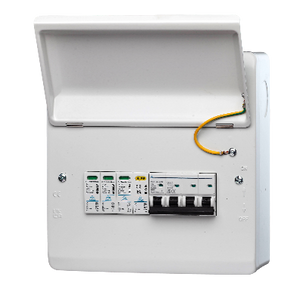
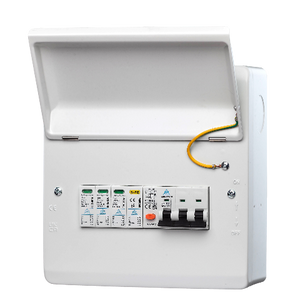
RCBO + Surge Protection – Fitted Consumer Unit IP40 – 3 Phase
Regular price From £65.00Regular price -


3-Phase PME PEN Fault Protection – 40A RCBO + Surge | Single EV Charger | BS7671 Compliant
Regular price From £65.00Regular price -
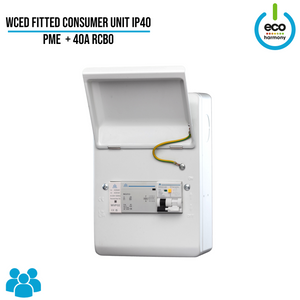
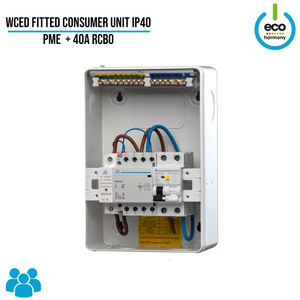
Fitted Consumer Unit IP40 – PME + 40A RCBO (Surge Protection + kWh Meter + Load Balancing Options Available)
Regular price From £80.00Regular price -
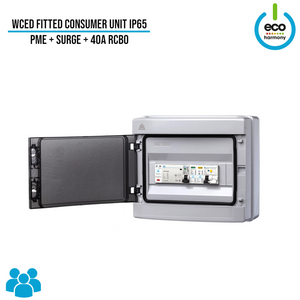
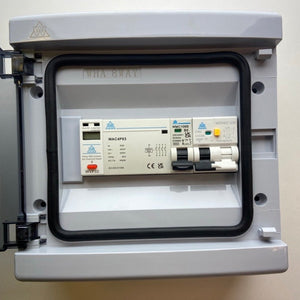
PEN Fault Detection + Surge Protection Device
Regular price From £77.50Regular price -
Save £2.50
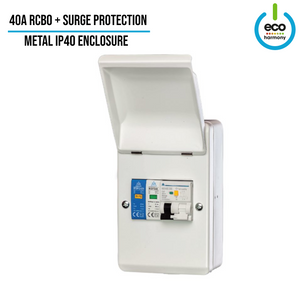
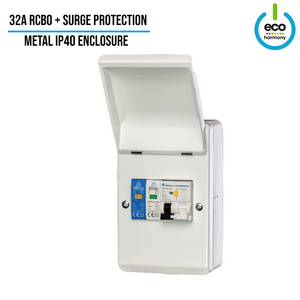
RCBO + Surge Protection Fitted Consumer Unit (IP30 / Indoor Use)
Regular price £32.50Regular price£35.00-£2.50 Sale price £32.50 -
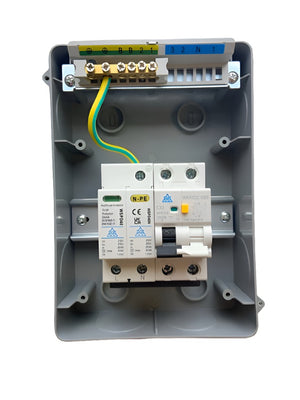
IP65 Consumer Unit with RCBO + Type 2 Surge Protection
Regular price £33.50Regular price£26.00Sale price £33.50


-


Simpson & Partners Cable Hook – Keep Your Charger Tidy & Stylish
Regular price £60.00Regular price -
Save £30.00


Home Series 7kW EV Charger – Type 2 Socket
Regular price From £550.00Regular price£580.00-£30.00 Sale price From £550.00 -


Home Series 7 kW Home EV Charger, Type 2 Tethered
Regular price From £620.00Regular price -


Free Colour Sample Card – Simpson & Partners EV Chargers
Regular price £0.00Regular price -
Sold out


Simpson & Partners Wireless Energy Manager – Smarter, Safer Charging
Regular price From £95.00Regular price


