
Fully Assembled WCED Consumer Units for EV Charging — Explained
Fully Assembled WCED Consumer Units for EV Charging — Explained
A fully assembled WCED board puts every required protection layer for EV charging on a PME supply into one pre-wired, pre-tested, IP65-rated unit. No component sourcing. No on-site assembly. Just install, connect, and sign off.
A fully assembled WCED (Wiring Centre with External Disconnection) consumer unit is a pre-built distribution board containing all the protection devices required for EV charging on a UK PME supply — PME fault monitoring, RCBO, and SPD — in one tested unit. It replaces the need for an earth rod, eliminates on-site component selection, and significantly reduces installation time.
If you're having a standard EV charger installed (any brand that isn't Simpson & Partners), your installer needs to add a protection box somewhere between your main supply and the charger. That box is the WCED board.
Instead of sourcing three separate devices — a PME monitor, a safety switch, and a surge protector — and wiring them together on-site, the WCED board has everything already built in and tested. Your installer bolts it on the wall, wires it up, and the job is done. Faster, cleaner, and with less room for error.
If you have a Simpson & Partners charger, the board is built into the charger itself — you don't need a separate WCED board at all.
What's Inside a Fully Assembled WCED Board
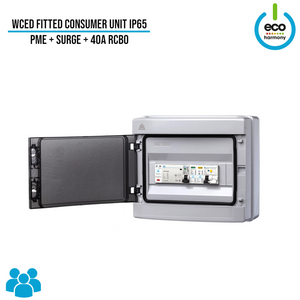
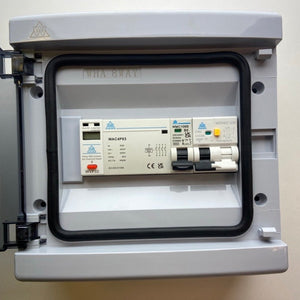
Every EcoHarmony WCED board contains all required protection layers for EV charging on a PME supply in a single pre-tested unit:
PME Protection Module
Continuously monitors supply voltage between L, N, and PE. Automatically disconnects the EV circuit when voltage falls outside 207–253V — the signature of a PEN fault condition upstream. This is the core function that satisfies BS 7671 Reg 722.411.4.1.
Type A RCBO
Residual Current Breaker with Overcurrent — provides AC earth leakage protection (30mA) and overcurrent / short circuit protection for the EV charging circuit. Minimum standard under BS 7671 Section 722 for all EV installations.
Type 2 SPD
Surge Protection Device — protects the charger and vehicle electronics against transient voltage spikes from lightning strikes and switching events. Recommended by BS 7671 Chapter 44 for all outdoor EV installations.
IP65 Weatherproof Enclosure
Sealed against dust and water jets. Suitable for external installation in all UK weather conditions. All components pre-wired to manufacturer specification and tested as a complete system before dispatch.
Why this matters: On-site assembly of individual components introduces risk — wrong device selection, wiring errors, missing components. A pre-assembled, tested board eliminates all of this. What arrives is what installs, and what installs is what's been tested to work together.
Traditional Build vs Fully Assembled WCED — Installation Comparison
| Factor | Traditional On-Site Build | Fully Assembled WCED Board |
|---|---|---|
| Component sourcing | PME device, RCBO, SPD all sourced separately | All included in one unit |
| On-site assembly time | 30–60 mins component wiring + testing | Pre-assembled — wiring connections only |
| Risk of component mismatch | Present — devices must be compatible | Eliminated — pre-tested as a system |
| Enclosure required? | Must source and mount separately | IP65 enclosure included |
| Typical total install time | ~3–4 hours including assembly | ~45–60 minutes wiring only |
| Commissioning documentation | Individual device records | Single board commissioning record |
| Earth rod needed? | Only if no PME device — else No | No — PME module handles it |
The Protection Stack — How Each Component Works Together
The three protection layers inside a WCED board address three completely separate fault types. They're not redundant — each is essential:
PME module — what it does and when it acts
The PME module monitors the supply voltage relationship between L, N, and PE at the board's supply terminals. Under normal operation it does nothing — the charger runs normally through it. When a PEN conductor fails upstream on the TN-C-S network, the voltage profile changes: it typically falls below 207V or rises above 253V. The PME module detects this in milliseconds and disconnects the output to the EV charger — before the installation earth can rise to dangerous voltage levels.
This is the function that satisfies BS 7671 Regulation 722.411.4.1 and eliminates the need for an earth rod.
RCBO — circuit-level leakage and overcurrent protection
The Type A RCBO monitors current balance between live and neutral within the EV charging circuit. If current imbalance is detected (indicating earth leakage) at 30mA, it trips. If current exceeds the rated level (overload) or there is a short circuit, it also trips.
This is a completely separate protection function from the PME module — the RCBO monitors within-circuit faults; the PME module monitors upstream supply faults. Both are required; neither replaces the other.
SPD — transient overvoltage protection
The Type 2 Surge Protection Device provides transient voltage clamping — absorbing brief voltage spikes caused by lightning strikes on overhead lines, switching events in the DNO network, or other transient disturbances. Without an SPD, these spikes can damage the charger's electronics or the vehicle's onboard charging system.
BS 7671 Chapter 44 requires a risk assessment for surge protection on all new installations. For most outdoor EV installations on UK networks, the risk assessment result is positive — an SPD is recommended. Including it in the WCED board means this requirement is met without an additional device.
What about RDC-DD (DC leakage detection)?
RDC-DD detects smooth DC leakage from EV charger electronics that can blind a Type A RCD. Whether an RDC-DD is required depends on the specific EV charger — some chargers handle DC leakage internally; others specify a Type B RCBO or external RDC-DD.
Always check the EV charger manufacturer's installation manual for their specific requirement. If an RDC-DD is needed, it can be added upstream of the WCED board or at the consumer unit, or a Type B RCBO can replace the Type A RCBO in the board configuration.
Understanding RCBO, RCD, and MCB — The Building Blocks
WCED boards are built around these core protection components. Here's what each one does:
What is an RCBO?
An RCBO (Residual Current Breaker with Overcurrent) combines two functions in one device: earth leakage detection (like an RCD) and overcurrent/short circuit protection (like an MCB). For EV charging circuits, this is the preferred single-device solution — it protects against circuit faults without causing a whole-board trip.
RCBO: Type A vs Type B — which do you need?
Type A RCBO: Detects AC earth leakage and pulsating DC leakage. Minimum standard for most EV charging circuits. Used in standard WCED board configurations.
Type B RCBO: Also detects smooth DC leakage in addition to AC and pulsating DC. Required when the EV charger's installation spec specifies it — eliminates the need for a separate RDC-DD. Can be specified as an alternative in WCED boards.
Always check your charger manufacturer's installation manual for the required RCBO type.
Why not a standard RCD + MCB?
A split-load consumer unit with a shared RCD protecting multiple circuits is cheaper upfront but creates "nuisance tripping" — a leakage fault on the EV circuit trips protection for other circuits too. An RCBO provides per-circuit protection: only the affected circuit disconnects.
For EV charging: RCBO is always the recommended approach — dedicated per-circuit protection, no interaction with other loads, simpler certification.
Where the WCED Board Fits in a UK EV Installation
Supply feed from main consumer unit
A dedicated circuit runs from the main consumer unit (or distribution board) to the WCED board. Typically 32A or 40A for 7kW single-phase. The WCED board's own RCBO protects this circuit — no additional device needed at the consumer unit for the EV supply.
WCED board — mounted near the charger
Typically within 1–2m of the charger, externally mounted in the IP65 enclosure. All power to the charger passes through the board. The board monitors supply continuously and provides all required protection layers. Often mounted to the same wall bracket as the charger.
EV charger connected downstream
Any standard EV charger connects to the WCED board's output. No changes to the charger configuration. Compatible with Zappi, Ohme, Hypervolt, Pod Point, Wallbox, Easee, and all other standard charger brands.
Commission and certify
Test supply voltage at the board input, verify RCBO operation, confirm PME disconnection behaviour per device documentation. Record on installation certificate as TN-C-S with external disconnection device (WCED). Board commissioning record documents the protection system.
WCED Boards Available from EcoHarmony
Single-Phase WCED PME Board
PME protection + Type A RCBO + Type 2 SPD. Fully assembled, IP65, pre-tested. Compatible with any standard EV charger. UK-stocked. Competitive trade pricing — volume discounts available from 5+ units.
View Single-Phase Boards →Three-Phase WCED PME Board
Three-phase PME protection + three-phase RCBOs + SPD. For 22kW EV charging and commercial installations on PME supplies. Fully assembled. Call for volume pricing and supply terms.
View Three-Phase Boards →Simpson & Partners Chargers
If the installation allows charger selection, Simpson & Partners chargers include integrated PME protection — no external WCED board needed. Often the fastest total installation path.
View Charger Range →Ready to simplify your EV install?
Fully assembled WCED boards — all protection layers, one unit, no assembly required. UK stock, fast dispatch.
Frequently Asked Questions
What is a fully assembled consumer unit for EV charging?
What does WCED stand for?
What's the difference between a WCED board and a standard consumer unit?
Do I need a WCED board if I have a Simpson & Partners charger?
What charger brands work with WCED boards?
Do I still need an earth rod with a WCED board?
What is an RCBO and why is it better than a separate RCD + MCB?
Does a WCED board include surge protection?
How do I know if I need a single-phase or three-phase WCED board?
Technical Glossary
-
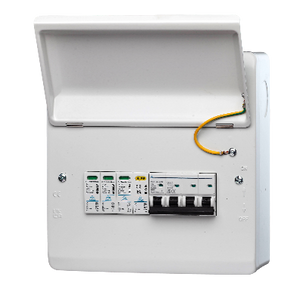
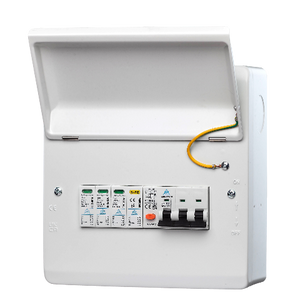
RCBO + Surge Protection – Fitted Consumer Unit IP40 – 3 Phase
Regular price From £65.00Regular price -


3-Phase PME PEN Fault Protection – 40A RCBO + Surge | Single EV Charger | BS7671 Compliant
Regular price From £65.00Regular price -
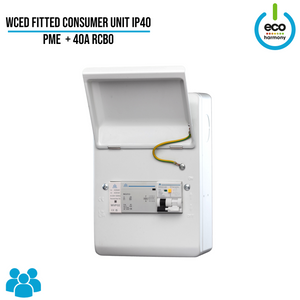
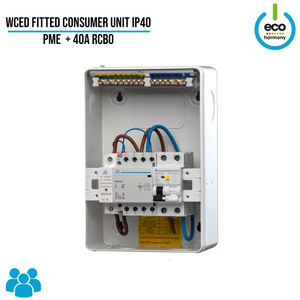
Fitted Consumer Unit IP40 – PME + 40A RCBO (Surge Protection + kWh Meter + Load Balancing Options Available)
Regular price From £80.00Regular price -
PEN Fault Detection + Surge Protection Device
Regular price From £77.50Regular price -
Save £2.50
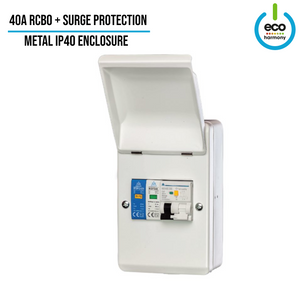
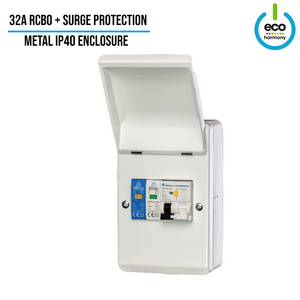
RCBO + Surge Protection Fitted Consumer Unit (IP30 / Indoor Use)
Regular price £32.50Regular price£35.00-£2.50 Sale price £32.50 -
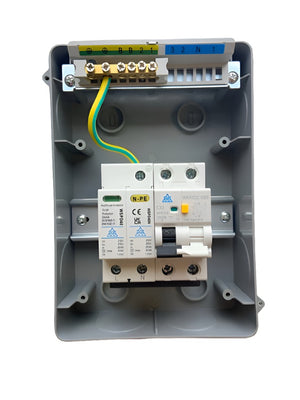
IP65 Consumer Unit with RCBO + Type 2 Surge Protection
Regular price £33.50Regular price£26.00Sale price £33.50


-


Simpson & Partners Cable Hook – Keep Your Charger Tidy & Stylish
Regular price £60.00Regular price -
Save £30.00


Home Series 7kW EV Charger – Type 2 Socket
Regular price From £550.00Regular price£580.00-£30.00 Sale price From £550.00 -


Home Series 7 kW Home EV Charger, Type 2 Tethered
Regular price From £620.00Regular price -


Free Colour Sample Card – Simpson & Partners EV Chargers
Regular price £0.00Regular price -
Sold out


Simpson & Partners Wireless Energy Manager – Smarter, Safer Charging
Regular price From £95.00Regular price


