
What is an RCBO? MCB vs RCD vs RCBO Explained
What is an RCBO? MCB vs RCD vs RCBO Explained
Walk into any electrical wholesaler in the UK and you'll encounter three device types on almost every job: MCBs, RCDs, and RCBOs. They look similar, fit the same DIN rail, and all trip when something goes wrong — but they protect against completely different types of fault. Understanding the difference isn't just useful for exam purposes; it directly affects how you design a board and what you specify for each circuit.
This guide explains what each device does, how they work, when each is required under BS 7671, and why RCBOs have become the standard for individual circuit protection in modern UK installations.
The three devices at a glance
| Device | Protects against | Does not protect against | Typical location |
|---|---|---|---|
| MCB — Miniature Circuit Breaker | Overload, short circuit | Earth leakage, arc faults | Consumer unit, distribution board |
| RCD — Residual Current Device | Earth leakage (30mA, 100mA, 300mA) | Overload, short circuit | Consumer unit (covers multiple circuits) |
| RCBO — Residual Current Breaker with Overload | Overload, short circuit, earth leakage | Arc faults (unless AFDD type) | Consumer unit (one per circuit) |
What does an MCB do?
An MCB protects the wiring on a circuit from damage caused by too much current. It does this in two ways: thermally (a bimetallic strip heats up and bends to trip the device under sustained overload) and magnetically (an electromagnet trips the device almost instantly under a short circuit).
What an MCB cannot do is detect earth leakage — the small currents that flow when electricity finds an unintended path to earth, such as through a person. A 30 mA leakage current through a human body can cause cardiac arrest within seconds, but it is far too small to trip an MCB. For that, you need an RCD or RCBO.
What does an RCD do?
An RCD constantly monitors the balance of current flowing out on the live conductor and returning on the neutral. Under normal conditions these are equal. If current leaks to earth — through a fault, through a person, or through damaged insulation — the balance is broken. When the imbalance reaches the trip threshold (typically 30 mA for personal protection), the RCD trips within 40 milliseconds.
The limitation of a standalone RCD is that it provides no overcurrent protection. If a circuit draws twice its rated current continuously, the RCD will not trip — that is the MCB's job. Traditional split-load boards used a combination of a main RCD covering one half of the board and MCBs on each circuit. The problem: one earth fault anywhere on that half trips everything, not just the faulty circuit. This is why RCBOs replaced the split-load approach in modern boards.
What does an RCBO do?
An RCBO combines both functions — overcurrent (MCB) and earth leakage (RCD) — in a single module that occupies one way in a consumer unit. Each circuit gets its own independent protection. A fault on one circuit trips only that circuit, not half the board.
This is the primary practical advantage of RCBO-only boards: fault selectivity. When a circuit trips, you know exactly which one has the fault. With a split-load RCD arrangement, a leakage fault on any one of the circuits covered by that RCD takes out all of them simultaneously.
B-curve vs C-curve — what does the letter mean?
The letter on an MCB or RCBO describes its instantaneous trip characteristic — how many times the rated current is needed to cause an immediate magnetic trip:
| Curve | Instantaneous trip range | Typical application |
|---|---|---|
| B curve | 3–5× rated current | Lighting, sockets, general domestic circuits — resistive loads |
| C curve | 5–10× rated current | Motors, compressors, air conditioning — inductive loads with high start-up current |
| D curve | 10–20× rated current | High inrush loads, transformers, specialist industrial equipment |
For the vast majority of domestic and light commercial circuits, B-curve is the correct specification. C-curve is used where equipment draws a brief but large inrush current on start-up that would cause a B-curve device to nuisance-trip.
Type A vs Type B — what does the type mean?
The Type classification on an RCBO or RCD describes what kind of residual current it can detect:
| Type | Detects | Required for |
|---|---|---|
| Type AC | AC residual currents only | Legacy — no longer recommended for new installations |
| Type A | AC + pulsating DC up to 6 mA | Standard for most domestic circuits, most EV chargers |
| Type B | AC + pulsating DC + smooth DC | 3-phase EV chargers, some industrial equipment |
| Type F | AC + pulsating DC + frequency-selective | Variable speed drives, inverter-driven equipment |
Type A is the minimum standard for all new domestic and commercial installations in the UK. Type B is specifically required where smooth DC leakage currents may be present — most commonly in 3-phase EV charger installations. See our dedicated guide: What is a Type B RCD?
When does BS 7671 require RCD protection?
Regulation 411.3.3 of BS 7671:2018 requires 30 mA RCD protection for all socket outlets rated up to 20A (with limited exceptions), all circuits supplying mobile equipment outdoors, all circuits in bathrooms and shower rooms, all circuits in locations with increased shock risk, and all circuits in consumer units not installed in a locked enclosure. In practice, for modern domestic and light commercial boards, this means virtually every circuit requires an RCBO or equivalent RCD protection. The simplest way to achieve this is a fully RCBO-equipped board.
Key Features of WCED RCBOs
Single-module Type A RCBOs in B and C curve, 6A to 40A. In stock with next working day dispatch.
View RCBO range →Frequently Asked Questions
Can I replace an RCD and MCB with a single RCBO?
Yes — that is exactly what an RCBO does. It replaces both the circuit MCB and the upstream RCD coverage for that circuit in a single module. Modern consumer units are typically built with one RCBO per circuit rather than a main RCD covering multiple circuits.
Do I need an RCBO on every circuit?
Under BS 7671:2018, virtually all final circuits in domestic installations require 30 mA RCD protection. Using a single RCBO per circuit is the cleanest and most compliant way to achieve this, as it provides fault selectivity — only the faulty circuit trips, not the entire board.
What is the difference between a single-module and double-module RCBO?
A single-module RCBO is 17.8 mm wide and occupies one way in a consumer unit — the standard for domestic installations. A double-module (2-pole) RCBO is wider and switches both live and neutral — used for 240V circuits where both conductors must be isolated, such as some commercial applications.
Why does my RCBO keep tripping?
RCBOs trip for three reasons: overcurrent (a load drawing more than the rated current), earth leakage (current escaping to earth through a fault or damaged equipment), or nuisance tripping from high-frequency noise in some electronic equipment. The lever position after a trip can help identify the cause — check whether it has tripped to the middle position (RCD trip) or fully down (overcurrent trip).
What is the difference between an RCBO and an AFDD?
An AFDD (Arc Fault Detection Device) is an RCBO with an additional layer — a microprocessor that continuously monitors the circuit waveform for arc fault signatures caused by loose connections or damaged cables. An AFDD RCBO provides four layers of protection: overcurrent, short circuit, earth leakage, and arc fault detection. See: Arc fault detection (AFDD) explained
Electrical Safety Knowledge Base
All guides covering electrical protection devices, surge protection, and enclosures for UK installers and homeowners.
-
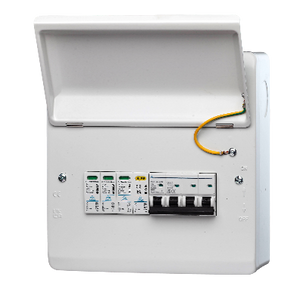
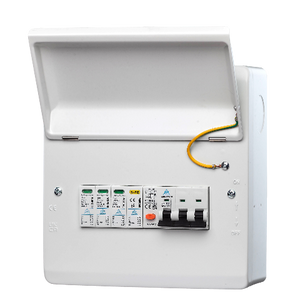
RCBO + Surge Protection – Fitted Consumer Unit IP40 – 3 Phase
Regular price From £69.00Regular price -

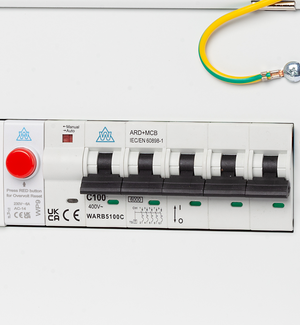
3-Phase PME PEN Fault Protection – 40A RCBO + Surge | Single EV Charger | BS7671 Compliant
Regular price From £85.00Regular price -
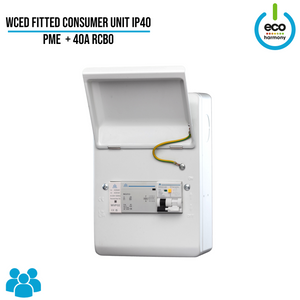
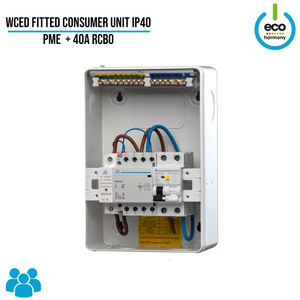
Fitted Consumer Unit IP40 – PME + 40A RCBO (Surge Protection + kWh Meter + Load Balancing Options Available)
Regular price From £88.00Regular price -
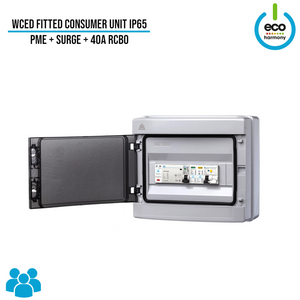
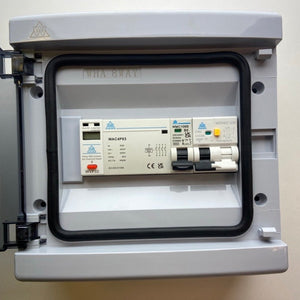
Fitted Consumer Unit IP65 - PME + 40A RCBO + Surge Protection
Regular price From £82.50Regular price -
Save £2.50
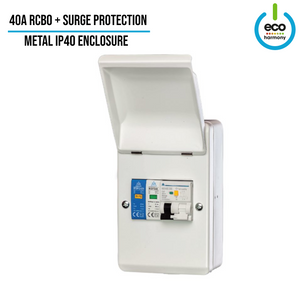
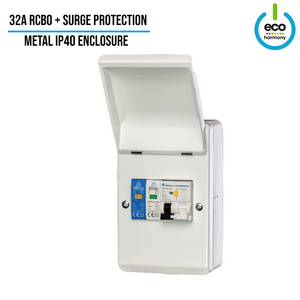
RCBO + Surge Protection Fitted Consumer Unit (IP30 / Indoor Use)
Regular price £32.50Regular price£35.00-£2.50 Sale price £32.50 -
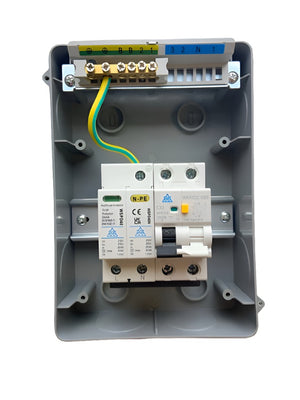
IP65 Consumer Unit with RCBO + Type 2 Surge Protection
Regular price £33.50Regular price£26.00Sale price £33.50

-


Simpson & Partners Cable Hook – Keep Your Charger Tidy & Stylish
Regular price £60.00Regular price -


Home Series 7 kW Plus Home EV Charger, Type 2 Tethered
Regular price From £665.00Regular price -


Home Series 7kW Plus EV Charger – Type 2 Socket
Regular price From £615.00Regular price -


Home Series 7kW Basic EV Charger – Type 2 Socket
Regular price £520.00Regular price -


Free Colour Sample Card – Simpson & Partners EV Chargers
Regular price £0.00Regular price


