
Arc Fault Detection (AFDD) Explained | UK Guide |
Arc Fault Detection (AFDD) Explained
Electrical fires are the most common cause of accidental house fires in the UK. A significant proportion start not because of overloaded circuits or obvious faults, but because of arc faults — electrical discharges that jump across damaged insulation, loose connections, or pinched cables. These arcs generate temperatures exceeding 6,000°C and can ignite surrounding materials long before the current reaches a level that would trip a standard MCB or RCD.
AFDDs were developed specifically to close this gap. They use a microprocessor to continuously analyse the electrical waveform on a circuit and identify the characteristic high-frequency signature of dangerous arcing — something that is impossible for a purely electromechanical device to detect.
Series arc faults vs parallel arc faults
| Arc type | Where it occurs | Common causes | Detectable by MCB/RCD? |
|---|---|---|---|
| Series arc | In-line with the conductor (L or N) | Loose terminal, broken conductor, rodent damage to cable | ❌ No — current is limited by the arc resistance |
| Parallel arc | Between conductors (L-N or L-E) | Damaged insulation, crushed/pinched cable, nail through wire | ⚠️ Only if current exceeds the MCB trip threshold |
| Both types | — | — | ✅ Yes — AFDD detects both series and parallel |
The series arc fault is the most dangerous from a detection standpoint. Because the arc introduces resistance into the circuit, the current actually drops — making it invisible to an MCB. The arc can sustain itself for minutes at temperatures high enough to ignite cable insulation, skirting boards, and wall plaster, all while drawing a completely normal-looking current.
How an AFDD detects arc faults
Arc faults produce a characteristic signature in the electrical waveform: irregular current spikes, high-frequency noise, and a distinctive pattern of zero-crossings. A microprocessor inside the AFDD continuously samples the waveform, applies pattern recognition algorithms, and compares what it sees against a library of known arc fault signatures.
The challenge — and where the technology has matured significantly — is distinguishing genuine arc faults from the high-frequency noise produced by normal switching loads: light dimmers, motor start-up, power tools, and electronic equipment. Modern AFDDs like the WCED WFD series use high-immunity filtering to minimise nuisance tripping while maintaining sensitivity to genuine arc conditions.
When is an AFDD mandatory in the UK?
Since March 2022, BS 7671:2018 Amendment 2 requires AFDDs at the origin of all single-phase final circuits supplying socket outlets rated ≤32A in the following building types:
For all other domestic and commercial buildings, AFDDs are strongly recommended under BS 7671 as a fire risk reduction measure, but are not yet mandatory. Many insurers, housing associations, and social landlords now specify them regardless. Industry expectation is that the mandatory requirement will extend to all new domestic builds in a future amendment.
AFDD RCBO — four protections in one module
| Protection function | MCB | RCBO (Type A) | AFDD RCBO (WCED WFD series) |
|---|---|---|---|
| Short circuit | ✅ | ✅ | ✅ |
| Overload | ✅ | ✅ | ✅ |
| Earth leakage (30mA) | ❌ | ✅ | ✅ |
| Arc fault detection | ❌ | ❌ | ✅ |
Single-module AFDD RCBOs in 6A to 40A. BS EN 62606 compliant. Drop-in replacement for any single-module RCBO. In stock with next working day dispatch.
View AFDD RCBOs →Frequently Asked Questions
Do AFDDs cause nuisance tripping?
Early AFDD devices had a reputation for nuisance tripping on dimmer switches, power tools, and variable-speed equipment. Modern devices including the WCED WFD series use improved filtering algorithms that significantly reduce this. The built-in LED blink-code indicator helps identify whether a trip was caused by arc detection, RCD, or overcurrent — making fault finding straightforward.
Will an AFDD fit in my existing consumer unit?
Yes — AFDD RCBOs are single-module width (17.8 mm) and are a direct drop-in replacement for any standard single-module RCBO. No consumer unit change is required, which makes them ideal for retrofit upgrades and EICR remediation works in HMOs and rental properties.
How do I know if a building requires AFDDs?
Any building classified as an HMO under the Housing Act 2004, any care home, any purpose-built student accommodation, or any residential building over 18m high or 6+ storeys in height requires AFDDs on socket circuits ≤32A. If you are unsure of the classification, the local authority housing team or building control can confirm.
Can I mix AFDD RCBOs and standard RCBOs in the same board?
Yes. There is no requirement to retrofit all circuits with AFDDs at once. A common approach during EICR remediation is to upgrade the socket circuits (which require AFDDs in HMOs) while leaving lighting and dedicated circuits on standard RCBOs. The WCED WFD series is compatible with standard consumer units alongside existing RCBO modules.
Electrical Safety Knowledge Base
All guides covering electrical protection devices, surge protection, and enclosures for UK installers and homeowners.
-
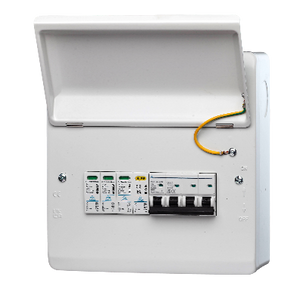
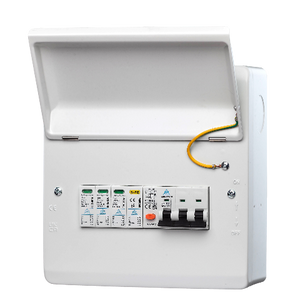
RCBO + Surge Protection – Fitted Consumer Unit IP40 – 3 Phase
Regular price From £69.00Regular price -

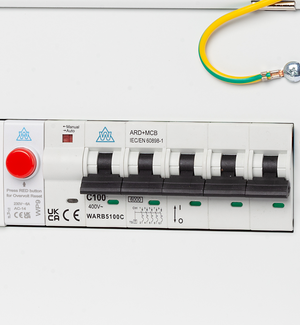
3-Phase PME PEN Fault Protection – 40A RCBO + Surge | Single EV Charger | BS7671 Compliant
Regular price From £85.00Regular price -
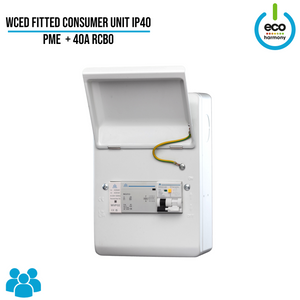
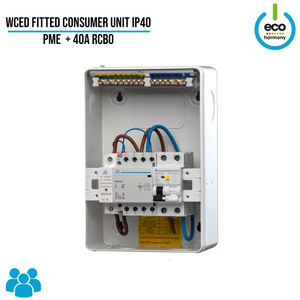
Fitted Consumer Unit IP40 – PME + 40A RCBO (Surge Protection + kWh Meter + Load Balancing Options Available)
Regular price From £88.00Regular price -
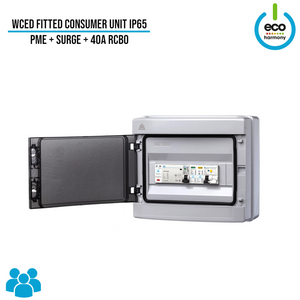
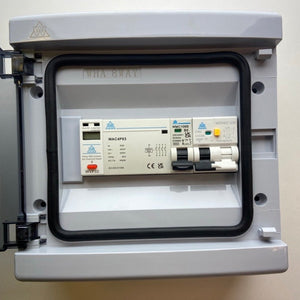
Fitted Consumer Unit IP65 - PME + 40A RCBO + Surge Protection
Regular price From £82.50Regular price -
Save £2.50
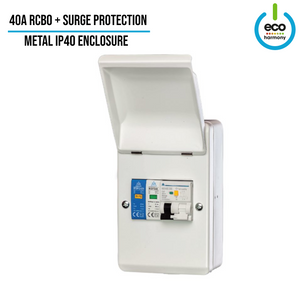
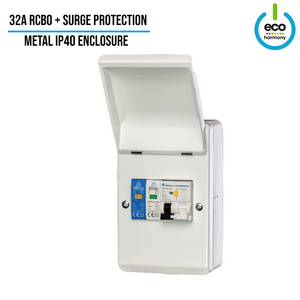
RCBO + Surge Protection Fitted Consumer Unit (IP30 / Indoor Use)
Regular price £32.50Regular price£35.00-£2.50 Sale price £32.50 -
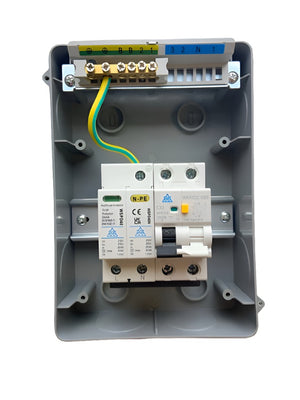
IP65 Consumer Unit with RCBO + Type 2 Surge Protection
Regular price £33.50Regular price£26.00Sale price £33.50

-


Simpson & Partners Cable Hook – Keep Your Charger Tidy & Stylish
Regular price £60.00Regular price -


Home Series 7 kW Plus Home EV Charger, Type 2 Tethered
Regular price From £665.00Regular price -


Home Series 7kW Plus EV Charger – Type 2 Socket
Regular price From £615.00Regular price -


Home Series 7kW Basic EV Charger – Type 2 Socket
Regular price £520.00Regular price -


Free Colour Sample Card – Simpson & Partners EV Chargers
Regular price £0.00Regular price


