

TL;DR:
- A premium EV charger must ensure compliance safety modularity and network integration.
- Top models include ChargePoint Express Solo Alpitronic HYC series and Kempower C-Series.
- Proper installation, including load calculation permit compliance and surge protection, is vital for success.
Selecting a premium EV charger for a commercial or residential project is rarely straightforward. You are balancing power output, network compatibility, physical resilience, and a growing list of compliance requirements, all before a single cable is pulled. For installers, electricians, and property developers, getting this decision wrong is costly in time, money, and reputation. This article walks you through what genuinely separates a premium charger from the rest, highlights the leading models worth specifying, and gives you the technical and compliance context to make confident, well-informed decisions on your next project.
Table of Contents
- What makes an EV charger premium?
- Top premium EV charger examples and leading models
- How premium chargers compare: key features and performance
- Critical compliance and installation factors for premium chargers
- Installer perspective: what matters most in premium EV charging
- Find premium-compliant EV solutions with EcoHarmony
- Frequently asked questions
Key Takeaways
| Point | Details |
|---|---|
| Premium charger must-haves | Top chargers blend compliance, modularity, and integrated safety for installer confidence. |
| Performance leader examples | ChargePoint Express Solo and Alpitronic HYC offer industry-leading power and uptime. |
| Comparer table | A side-by-side table clarifies strengths, features, and best use-cases by charger. |
| Compliance essentials | Following NEC standards and installer best practice is key for safe, efficient deployment. |
What makes an EV charger premium?
The word “premium” gets used loosely in the EV charging industry. Manufacturers apply it to everything from basic wall units with a polished finish to genuinely engineered systems built for demanding, high-throughput environments. For installers and developers, the definition needs to be more precise.
A truly premium EV charger delivers on four core dimensions: compliance, safety, modularity, and network integration. Strip any one of those away and you have a product that will create problems down the line, whether that is a failed inspection, an insurance dispute, or a charger that is offline when your client needs it most.
Premium chargers prioritise OCPP compliance, modular designs for uptime, integrated safety features such as DC residual current detection, and dynamic load management to mitigate grid strain. Installers must also verify which edition of the NEC (National Electrical Code) or equivalent regional standard the local authority having jurisdiction (AHJ) is enforcing, as this directly affects required protective features.
Here is what to look for when assessing whether a charger genuinely qualifies as premium:
- OCPP compliance: Open Charge Point Protocol (OCPP) allows the charger to communicate with any compatible network management system, giving operators flexibility and future-proofing.
- DC residual current monitoring: This detects dangerous DC fault currents that standard RCDs miss. You can explore DC residual current monitors as a standalone protection layer where chargers do not include this natively.
- Dynamic load management: Prevents the site from exceeding its agreed supply capacity by intelligently distributing available power across connected vehicles.
- Modular architecture: Allows individual power modules to be replaced without taking the entire unit offline. This is critical for commercial sites where downtime is a direct revenue loss.
- Robust physical build: IP54 rating or higher, IK10 impact resistance, and stainless or powder-coated housing for outdoor resilience.
- PME and PEN fault protection: Essential for any installation on a TN-C-S supply. Read more about PEN protection explained to understand why this is non-negotiable on most UK domestic and commercial sites.
Pro Tip: Always confirm which NEC edition your AHJ is enforcing before finalising your specification. Some authorities are still working from the 2020 edition, while others have adopted 2023, which introduces additional AFCI and load management provisions that affect your circuit design.
A useful installer checklist for assessing premium suitability includes: confirming OCPP version support (1.6 or 2.0.1), checking for integrated or compatible DC fault detection, verifying the charger’s load management capability, reviewing the manufacturer’s uptime SLA and modular repair options, and confirming physical protection ratings match the installation environment.
Top premium EV charger examples and leading models
With a clear definition in place, it is time to look at the models that consistently appear on premium project specifications. These are the chargers that experienced installers return to because they deliver on performance, reliability, and support.
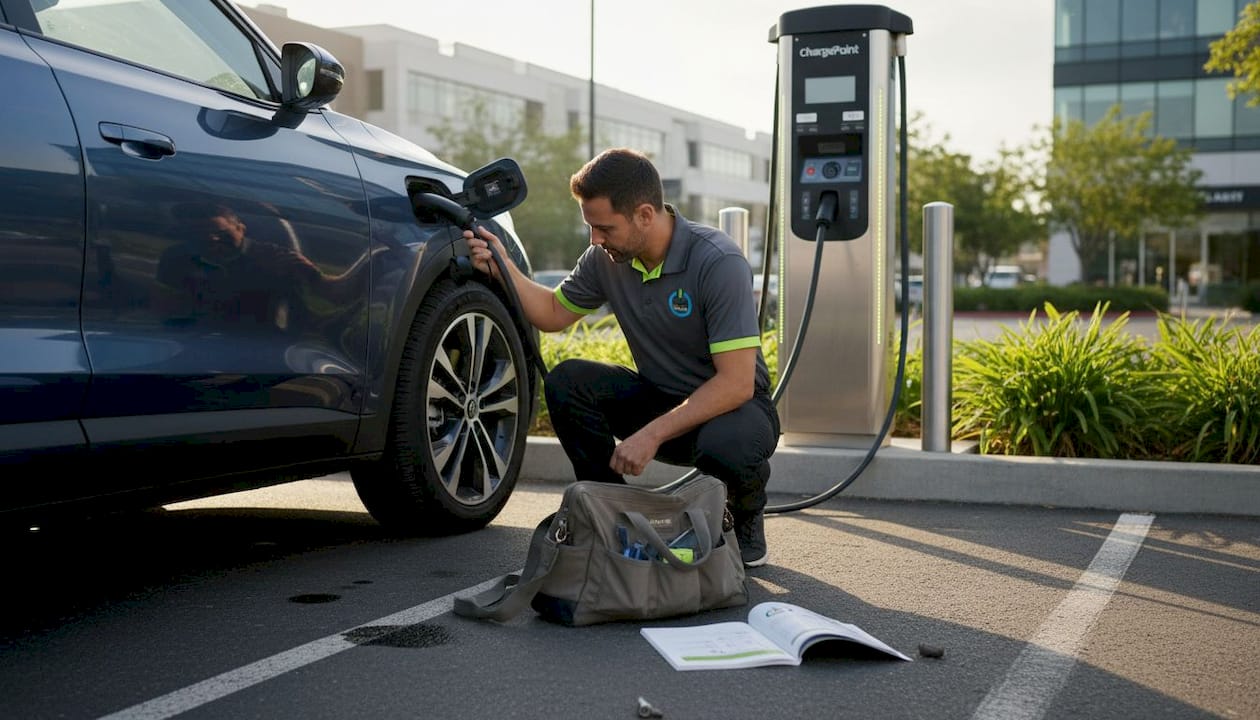
ChargePoint Express Solo stands at the top of the DC fast charging category. Delivering up to 600kW, it is the world’s fastest standalone charger for mass-market passenger vehicles. Its modular architecture allows simultaneous charging of up to four vehicles from a single unit, which addresses both grid constraints and the practical reality of busy commercial forecourts. For developers planning motorway service areas or high-footfall retail destinations, the Express Solo is a serious specification choice.
Alpitronic HYC series is the benchmark for commercial heavy-duty applications. Independent performance testing places it at 96.54% overall performance, combining a 95% session success rate with 97% uptime. These figures matter enormously when you are advising a client on the reliability case for their investment.
Kempower C-Series scores 93.85% in the same benchmarking data, making it a strong second-tier option for sites where the Alpitronic’s price point is prohibitive. It offers excellent scalability, allowing you to start with a smaller installation and add capacity as demand grows.
“DC fast chargers like the Alpitronic HYC series top performance benchmarks with a 96.54% score, combining a 95% session success rate with 97% uptime. Higher complexity does lead to more downtime compared to Level 2 chargers, which achieve 78 to 99% reliability across networks.”
For Level 2 applications, the picture is different. Level 2 chargers operate at up to 22kW and are the right choice for the majority of workplace, residential, and destination charging projects. The SimplEV 22kW charger is a well-regarded option in this category, offering OCPP connectivity, load management, and a straightforward installation process that suits both new builds and retrofit projects.
For installers working on premium domestic or boutique commercial projects, Simpson & Partners premium models represent a compelling proposition. UK-engineered, design-led, and compatible with smart tariffs and solar generation, they combine aesthetic quality with the technical features that modern EV users expect.
Key considerations when matching a charger model to a site:
- High-traffic, short-dwell sites (motorway services, fuel forecourts): DC fast chargers with modular architecture and high uptime ratings.
- Workplace and destination charging (offices, hotels, retail parks): Level 2 chargers with load management and network connectivity.
- Premium residential and boutique commercial: Design-led Level 2 units with solar and smart tariff integration.
- Multi-EV commercial sites: Pair any of the above with 3-phase multi-EV surge protection to ensure the installation is protected at the supply level.
How premium chargers compare: key features and performance
Having seen top models individually, it is time to compare their strengths side by side. This comparison focuses on the metrics that matter most to installers and developers: power output, simultaneous charge capability, compliance certifications, modularity, and uptime.
| Charger model | Max power output | Simultaneous vehicles | Modularity | OCPP support | Typical uptime |
|---|---|---|---|---|---|
| ChargePoint Express Solo | Up to 600kW | Up to 4 | Yes | Yes (1.6/2.0.1) | High |
| Alpitronic HYC series | Up to 400kW | Up to 4 | Yes | Yes | 97% |
| Kempower C-Series | Up to 300kW | Up to 4 | Yes | Yes | 93.85% |
| SimplEV 22kW | 22kW | 1 per unit | No | Yes | 95%+ |
| Simpson & Partners | Up to 22kW | 1 per unit | No | Yes | 95%+ |
A few important observations from this comparison:
- DC fast chargers offer higher throughput but come with greater complexity, higher capital cost, and more demanding maintenance requirements.
- Level 2 chargers deliver better ROI for most property-based applications. Level 2 is preferred for properties where utilisation is steady, maintenance costs need to be controlled, and the dwell time of users is measured in hours rather than minutes.
- A hybrid strategy combining DC fast charging for peak demand with Level 2 for overnight or extended stays often delivers the best overall outcome for mixed-use developments.
- Incentives and tax credits can significantly alter the financial case. In the UK, schemes such as the Workplace Charging Scheme reduce upfront costs, while in the US the 30C tax credit covers 30% of installation costs up to $100,000.
For installers advising clients on the Level 2 versus DC fast charging decision, the honest answer is that maximum power is rarely the deciding factor. Uptime, network flexibility, and total cost of ownership matter far more over a five to ten year asset life. Pairing any charger with quality DC surge protection solutions and robust PEN fault protection ensures the installation performs reliably across that full lifespan.
You can find more detailed technical guidance in our installer insights section, which covers real-world deployment scenarios and lessons from completed projects.
Critical compliance and installation factors for premium chargers
Understanding charger capabilities is vital, but installation success depends equally on compliance and precise site execution. A premium charger installed without proper circuit sizing, permitting, or protection is a liability, not an asset.
Follow these steps to ensure every premium charger installation meets the required standard:
- Perform a load calculation first. Before specifying any charger, complete a full NEC Article 220 load calculation to confirm the site’s available capacity and identify any upgrade requirements.
- Size branch circuits correctly. NEC Article 625 requires EVSE to be treated as a continuous load. Branch circuits must be sized at 125% of the charger’s rated current. A 32A charger, for example, requires a 40A dedicated circuit.
- Secure permits and schedule inspections. Permits are mandatory. Do not treat them as optional paperwork. An uninspected installation can void warranties, invalidate insurance, and create serious liability for the installer.
- Install GFCI protection for outdoor units. Ground Fault Circuit Interrupter protection is required for any outdoor EVSE under NEC Article 625. This is in addition to any DC residual current monitoring built into the charger itself.
- Use Class 2 data circuits for networked chargers. Keeping data wiring separate from power circuits reduces interference and protects the charger’s communication systems.
- Phase conduit installations carefully. Plan conduit routes before any groundwork begins. Retrofitting conduit through finished structures is expensive and disruptive.
- Include vandalism protection from the start. Bollards, secure mounting, and robust enclosures are far cheaper to install during the initial project than to add after the first incident.
Pro Tip: Accurate metering is not just a billing requirement. NIST Handbook 44 compliance for billing accuracy protects your client from disputes and ensures the charging station can operate as a revenue-generating asset. Specify metering-grade accuracy from the outset.
The 2023 NEC update also introduces AFCI (Arc Fault Circuit Interrupter) provisions and expanded load management requirements. These are not universally enforced yet, but specifying to the 2023 standard future-proofs the installation and demonstrates a level of professionalism that clients notice.
| Minimum installation requirement | Standard reference | Notes |
|---|---|---|
| Branch circuit at 125% rated current | NEC Article 625 | Mandatory for all EVSE |
| GFCI protection (outdoor) | NEC Article 625 | Required for all exterior installs |
| Dedicated circuit | NEC Article 625 | No shared circuits with other loads |
| PEN fault protection (UK TN-C-S) | BS 7671 / OZEV guidance | Mandatory for UK PME supplies |
| Surge protection device (SPD) | NEC Article 285 / BS 7671 | Strongly recommended for all installs |
| Metering accuracy | NIST HB44 | Required for billing applications |
For UK-specific compliance, PEN protection for compliance is an essential read before specifying any charger on a PME supply. The consequences of omitting this protection are serious and the regulatory expectation is clear.
Installer perspective: what matters most in premium EV charging
Here is something that does not appear in most buying guides: experienced installers will tell you that the charger model is rarely the part of the project that causes problems. It is everything around it.
Focusing purely on maximum power output is a common mistake, particularly among developers who equate higher kilowatts with better value. In reality, a 600kW DC fast charger on a site with inadequate grid connection, no surge protection, and a poorly designed earthing arrangement is a project waiting to go wrong. The hardware is only as good as the installation around it.
The small details consistently determine whether a project succeeds or fails. Robust surge protection, flexible network management, accurate metering, and physical security are the factors that keep a charging station operational and profitable over its full asset life. Cutting corners on any of these to save money upfront almost always costs more in the long run.
Compliance is not just a legal obligation. It is a professional reputation. One failed inspection or one insurance claim linked to a non-compliant installation can damage a business far more than the cost of doing the job properly in the first place. Regular consultation with your local authority is as important as benchmarking hardware specifications. Standards evolve, enforcement varies by region, and the installer who stays current with both is the one clients return to.
For practical, experience-led guidance on real-world deployments, our real-world installer insights section covers the lessons that do not appear in product datasheets.
Find premium-compliant EV solutions with EcoHarmony
Ready to act? Here is how EcoHarmony supports your next project with market-ready solutions.
EcoHarmony brings together the protection devices, charger hardware, and technical knowledge you need to deliver a complete, compliant EV charging installation. Whether you are specifying a new commercial site or retrofitting an existing property, the product range covers every layer of a well-built installation.
Explore the EPC 3.0 Protocol Controller for OCPP-compliant network management, or specify the SimplEV 22kW charger for a reliable, installer-friendly Level 2 solution. From surge protection and PEN fault detection to premium charger hardware, EcoHarmony electrical solutions give you the complete toolkit to deliver installations that perform, comply, and last.
Frequently asked questions
What is the main difference between Level 2 and DC fast premium chargers?
Level 2 is preferred for properties where ROI, reliability, and lower maintenance costs are priorities, while DC fast chargers suit high-traffic sites with short dwell times but bring greater complexity and higher capital cost.
How do I ensure my EV charger installation meets the latest compliance standards?
Verify which NEC edition your local authority is enforcing, size branch circuits at 125% of the charger’s rated current, and include GFCI and load management as required. NEC Article 625 and the 2023 updates covering AFCI and load management provisions are the key references.
Which premium charger models are recommended for multi-vehicle sites?
The ChargePoint Express Solo and Alpitronic HYC series are the strongest choices, offering high power output, modular architecture, and the ability to charge multiple vehicles simultaneously from a single installation.
What safety features are mandatory in premium EV charger installs?
Premium chargers require DC residual current monitoring, dedicated circuits, surge protection devices, and physical vandalism protection as core safety and compliance features for any well-specified installation.