
3-Phase Distribution Boards for Commercial EV Charging UK
3-Phase Distribution Boards for Commercial EV Charging UK
When a commercial site needs 5 or more EV charger circuits, individual protection boards for each charger stop making sense. A TPN (three-pole and neutral) distribution board provides centralised 3-phase power distribution, a single point of isolation, and a scalable foundation for any size commercial charging installation.
A TPN (Three-Pole and Neutral) distribution board distributes 3-phase power from the main supply to multiple EV charger circuits. Each circuit gets its own RCBO; the TPN board provides the main switch, surge protection, and a single point of isolation for the whole installation. EcoHarmony’s 125A TPN board with 4-pole main switch and SPD option is the standard specification for commercial EV charging sites with 5+ chargers.
Think of a TPN distribution board as the electrical equivalent of a motorway junction. The main supply arrives at the board — at 125A across three phases in a large commercial installation — and is then distributed to multiple outgoing circuits, each feeding one or more EV chargers.
Without a distribution board, every charger circuit would need its own supply run all the way back to the main incoming switchgear. That’s expensive in cable, time, and complexity. With a TPN board positioned close to the chargers, you run one large supply to the board and distribute from there — much more practical and cost-effective at scale.
The TPN board also provides a single point of isolation for the entire EV charging installation — one switch to make the whole area dead for maintenance. That’s an important safety and operational feature for any managed commercial site.
When Do You Need a TPN Distribution Board?
5 or more EV charger circuits
Below 5 chargers, multi-charger WCED boards are generally the most cost-effective solution. Above 5, a TPN distribution board with individual circuit RCBOs becomes more practical and economical.
Long cable runs to chargers
Where chargers are located far from the main incoming supply, a TPN board positioned near the charging area reduces total cable length significantly — one large supply cable to the board, short tails to each charger.
Phased installation plans
Where the site will grow — installing 6 chargers now with plans for 12 later — a correctly sized TPN board with spare ways accommodates expansion without rewiring the distribution.
Managed commercial sites
Car parks, hotel sites, fleet depots, and business parks where a single point of isolation and a clear distribution architecture are requirements of the site operator or property manager.
The EcoHarmony TPN Distribution Board
TPN Distribution Board — 125A 4-Pole Main Switch + SPD
The standard specification for commercial EV charging distribution. 125A 4-pole main switch for 3-phase + neutral isolation. Multiple outgoing ways for individual circuit RCBOs. Optional 4-pole SPD for surge protection at the distribution point. Sized for sites with 5–20+ charger circuits depending on individual charger draw.
- 125A 4-pole main isolating switch
- Three-phase + neutral distribution
- Multiple outgoing RCBO ways
- 4-pole SPD option for surge protection
- Suitable for 22kW charger circuits (32A per phase)
- Commercial grade — designed for managed site installation
How the Distribution Architecture Works
A well-designed commercial EV charging distribution typically follows this structure:
Main incoming supply
3-phase supply from the DNO (Distribution Network Operator) or landlord’s supply. On a PME supply, PEN fault detection is installed at or near the main incoming point — before the TPN distribution board.
TPN distribution board
Mounted close to the charging area. 125A 4-pole main switch provides a single isolation point for the entire EV charging installation. SPD at this point protects all downstream circuits. Individual outgoing ways for each charger circuit RCBO.
Individual circuit RCBOs
Each charger circuit (or pair of chargers if load-sharing) gets its own RCBO in the TPN board. 40A for 22kW chargers, 20–32A for lower-rated chargers. This provides the per-circuit residual current and overcurrent protection required by BS 7671.
EV chargers
Each charger fed directly from its RCBO. Cable sizing from the RCBO to the charger based on circuit length and installation method. Trunking or armoured cable for surface runs in car parks and outdoor areas.
PME protection placement on commercial sites
On a PME supply, PEN fault detection must be upstream of the EV charger circuits. On commercial sites, this is typically installed at the main incoming point or in a dedicated PME board upstream of the TPN distribution. The TPN board itself does not contain PME protection — that’s provided separately upstream. EcoHarmony can advise on the correct architecture for your specific site.
Sizing a TPN Distribution Board for EV Charging
| Site scale | Total charger capacity | Main switch rating | Cable to board (approx) |
|---|---|---|---|
| 5–6 chargers at 22kW | Up to 132kW | 125A 4-pole | 70mm² 4-core SWA (depending on diversity) |
| 8–10 chargers at 11kW | Up to 110kW | 125A 4-pole | 70mm² 4-core SWA (depending on diversity) |
| 10+ chargers with smart load management | Subject to diversity | 125A+ 4-pole | Designed to actual peak draw with load management |
Diversity is critical on commercial EV charging sites. A site with 10 × 22kW chargers does not draw 220kW simultaneously in most real-world scenarios — not all bays are occupied at peak times, and vehicles reach their onboard charge limit before the session ends. Proper diversity assessment significantly reduces supply and cable requirements. EcoHarmony can assist with diversity calculations for commercial specifications.
Commercial Site Types — Typical Specifications
Workplace charging (10–30 bays)
Typically 7kW or 11kW chargers for overnight or all-day dwell. Often split across multiple TPN sub-boards by zone. Smart load management usually specified to stay within supply limits during working hours.
Hotel & hospitality (4–20 bays)
Often 7kW for overnight stays, sometimes 22kW for day visitors. MID metering frequently specified for billing. A single TPN board typically covers the full installation unless the site is very large.
Car parks (20–100+ bays)
Multi-zone distribution with TPN boards per zone, connected to a main incoming panel. 22kW common for visitor charging. OCPP management system integration required for billing and access control.
Fleet depots
Overnight charging focus — high diversity, multiple vehicles drawing overnight means lower peak demand than rated capacity. Smart scheduling often eliminates the need for supply upgrades at existing sites.
Frequently Asked Questions
What is the difference between a TPN board and a standard consumer unit?
Does the TPN board include PME protection?
How many charger circuits can the 125A TPN board support?
What cable do I need from the main supply to the TPN board?
Do I need an SPD at the TPN board if there’s already an SPD at the main incoming?
Can the TPN board be expanded if the site grows?
Specifying a commercial EV charging installation?
Tell us the number of bays, charger power rating, and supply type — we’ll confirm the distribution architecture and product list.
Technical Glossary
-
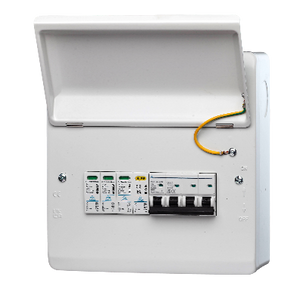
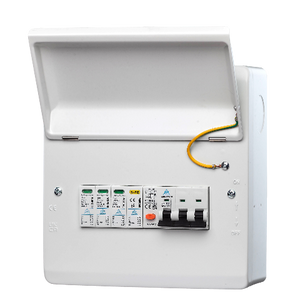
RCBO + Surge Protection – Fitted Consumer Unit IP40 – 3 Phase
Regular price From £65.00Regular price -


3-Phase PME PEN Fault Protection – 40A RCBO + Surge | Single EV Charger | BS7671 Compliant
Regular price From £65.00Regular price -
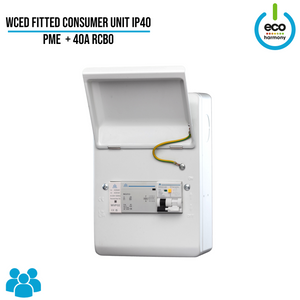
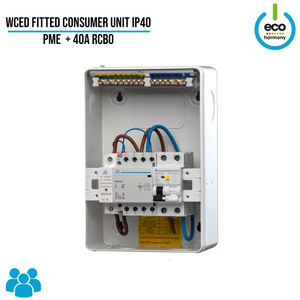
Fitted Consumer Unit IP40 – PME + 40A RCBO (Surge Protection + kWh Meter + Load Balancing Options Available)
Regular price From £80.00Regular price -
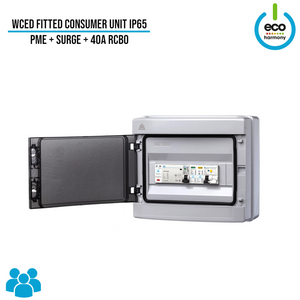
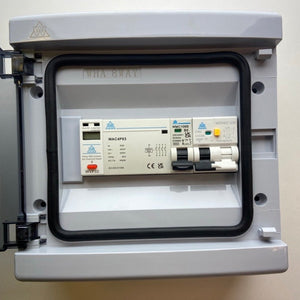
PEN Fault Detection + Surge Protection Device
Regular price From £77.50Regular price -
Save £2.50
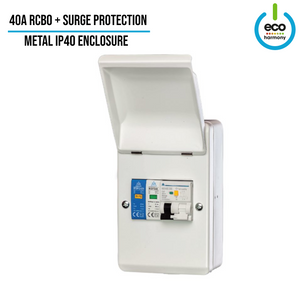
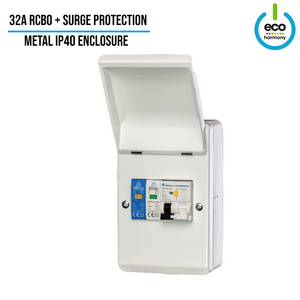
RCBO + Surge Protection Fitted Consumer Unit (IP30 / Indoor Use)
Regular price £32.50Regular price£35.00-£2.50 Sale price £32.50 -
IP65 Consumer Unit with RCBO + Type 2 Surge Protection
Regular price £29.50Regular price


