
Heat Pump Electrical Protection Requirements UK | RCD
Heat Pump Electrical Protection Requirements UK
Heat pumps are not standard electrical loads. They use inverter-driven variable speed compressors that generate DC and high-frequency leakage currents that a standard Type A RCD cannot detect. Getting the protection right isn’t optional — it’s a BS 7671 requirement, and it requires specific devices that most electricians don’t routinely stock.
Heat pumps require a Type B RCD (not Type A), which detects AC, pulsating DC, and smooth DC residual current. The inverter-driven compressor produces DC leakage that a Type A RCD is blind to. Where the inverter operates at frequencies above standard power frequency (common in modern high-efficiency units), a 20kHz Type B RCD is required. Both variants need a Type 2 SPD. EcoHarmony stocks pre-assembled heat pump consumer units with both Type B and 20kHz Type B options.
A standard Type A RCD detects two types of fault current: alternating (AC) and pulsating DC. It was designed for conventional electric loads — heaters, motors, lighting — that behave in predictable ways.
A heat pump is different. Its inverter converts AC power from the grid into variable-frequency AC to drive the compressor at different speeds. This conversion process introduces smooth DC leakage current as a by-product. Type A RCDs don’t detect smooth DC — that fault current passes straight through without tripping the device.
A Type B RCD adds smooth DC detection to its repertoire. It’s the same physical format as a Type A — it just detects more types of fault. That additional detection capability is what heat pump installations require under BS 7671.
Some modern high-efficiency heat pumps go further and operate their inverters at frequencies up to 20kHz (above the standard 50Hz power frequency). For these systems, an even more capable RCD — rated to 20kHz — is required. That’s what EcoHarmony’s 20kHz Type B consumer unit provides.
Why Heat Pumps Need Type B RCDs
Under BS 7671 Amendment 3 (2020) and subsequent guidance, equipment with inverter drives — which includes all modern heat pumps — must have RCD protection that is appropriate for the type of leakage current the equipment can produce.
| RCD Type | Detects AC faults | Detects pulsating DC | Detects smooth DC | Suitable for heat pumps? |
|---|---|---|---|---|
| Type AC | Yes | No | No | No |
| Type A | Yes | Yes | No | No — misses smooth DC leakage |
| Type B | Yes | Yes | Yes (up to 1kHz) | Yes — for standard inverter heat pumps |
| Type B 20kHz | Yes | Yes | Yes (up to 20kHz) | Yes — for high-frequency inverter systems |
Installing a heat pump with only a Type A RCD is a non-compliant installation
The smooth DC leakage from the heat pump inverter will pass through a Type A RCD without triggering it. If a genuine fault develops, the RCD may not trip — leaving the circuit unprotected. This is both a safety issue and a building regulations compliance failure.
Do You Need Standard Type B or 20kHz Type B?
This is the key specification question for heat pump installers and electricians, and the answer depends on the heat pump model.
Standard Type B RCD (up to 1kHz)
Covers the vast majority of air source and ground source heat pumps. The inverter operates at frequencies within the standard detection range. Suitable for most Vaillant, Daikin, Mitsubishi, Samsung, and similar residential heat pump models.
EcoHarmony product: Heat Pump Consumer Unit — Type B RCD + SPD + MCB — £135
20kHz Type B RCD
Required for variable refrigerant flow (VRF) systems, commercial heat pumps, and some high-efficiency residential units where the inverter switching frequency extends above 1kHz. Check the heat pump manufacturer’s electrical specification document for the stated inverter frequency range.
EcoHarmony product: WCED Heat Pump Protection CU — 20kHz Type B RCD + SPD — £235
How to check: The heat pump manufacturer’s installation manual will specify the type of RCD required. Look for wording like “Type B RCD required” or “frequency-sensitive RCD required”. If the manual specifies a Type B without frequency qualification, the standard Type B consumer unit (£135) is appropriate. If it specifies 20kHz or “high-frequency” RCD, use the 20kHz variant (£235).
SPD Requirements for Heat Pumps
Heat pumps contain sophisticated inverter electronics and control boards. These are significantly more vulnerable to transient overvoltages (lightning and switching surges) than simple resistive loads. BS 7671 Appendix 16 requires a Type 2 SPD where the risk assessment determines one is needed — for an outdoor heat pump unit, this is almost invariably the case.
Both EcoHarmony heat pump consumer units include a Type 2 SPD pre-wired and tested as part of the assembly. There is no need to source and specify an SPD separately.
Products for Heat Pump Installations
Heat Pump Consumer Unit — Type B RCD + SPD + MCB
Pre-assembled consumer unit for standard heat pump installations. Type B RCD (standard frequency) + Type 2 SPD + MCB protection. Covers the vast majority of residential air source and ground source heat pump models. BS 7671 compliant. Pre-wired, tested, and ready to install.
- Type B RCD (standard frequency, up to 1kHz)
- Type 2 SPD — pre-wired
- MCB protection
- BS 7671 compliant for inverter-driven heat pumps
- Suitable for: most Vaillant, Daikin, Mitsubishi, Samsung residential models
WCED Heat Pump Protection CU — 20kHz Type B RCD + SPD
Pre-assembled consumer unit for heat pumps with high-frequency inverters (VRF systems, commercial units, and high-efficiency residential models where the inverter operates above 1kHz). 20kHz Type B RCD + Type 2 SPD + main switch + MCBs. The comprehensive solution where the heat pump manufacturer specifies high-frequency RCD protection.
- 20kHz Type B RCD — covers high-frequency leakage currents
- Type 2 SPD — pre-wired
- Main switch for isolation
- MCB protection
- Suitable for: VRF systems, commercial heat pumps, high-spec residential units
Heat Pump + EV Charger on the Same Property
An increasingly common scenario: a homeowner installs both a heat pump and an EV charger. The protection requirements for each are different, and they share the incoming supply. Key considerations:
Separate circuits, separate protection
The heat pump and EV charger should be on separate dedicated circuits, each with appropriate protection. The Type B consumer unit for the heat pump is a separate installation from the WCED board for the EV charger.
Load balancing becomes important
A heat pump drawing up to 3–7kW simultaneously with an EV charger drawing 7kW represents a significant combined load on a typical 80A or 100A domestic supply. Load balancing on the EV charger circuit prevents supply overload during simultaneous operation.
PME protection applies to both
On a PME supply, both the heat pump circuit and the EV charger circuit require appropriate PME protection. The EV charger’s WCED board addresses this for the EV circuit; the heat pump consumer unit handles its own circuit protection (Type B RCD, not PME-specific).
Smart scheduling saves money
With an EV charger that supports smart tariff scheduling and a heat pump that can be programmed to run at off-peak times, the combined household energy cost can be significantly reduced. The two systems don’t need to talk to each other — scheduling each independently to off-peak windows is usually sufficient.
Frequently Asked Questions
Can I use a Type A RCBO in a heat pump consumer unit?
Does the heat pump consumer unit replace the main consumer unit?
How do I know if my heat pump needs 20kHz Type B or standard Type B?
Does a heat pump need its own consumer unit or can I use a spare way in the main board?
Do I need PME/PEN fault detection for a heat pump?
What rating MCB do I need for a heat pump circuit?
Can the heat pump and EV charger share a consumer unit?
Installing a heat pump?
Standard Type B at £135 or 20kHz Type B at £235. Tell us the heat pump model and we’ll confirm which is correct.
Technical Glossary
-
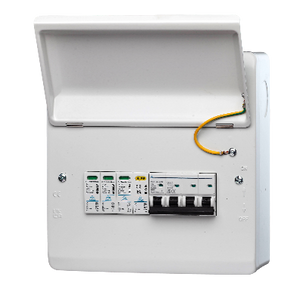

RCBO + Surge Protection – Fitted Consumer Unit IP40 – 3 Phase
Regular price From £65.00Regular price -

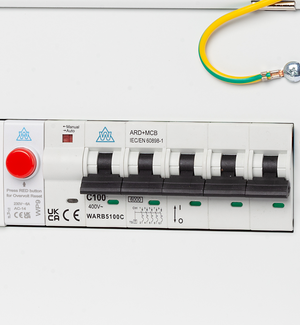
3-Phase PME PEN Fault Protection – 40A RCBO + Surge | Single EV Charger | BS7671 Compliant
Regular price From £65.00Regular price -
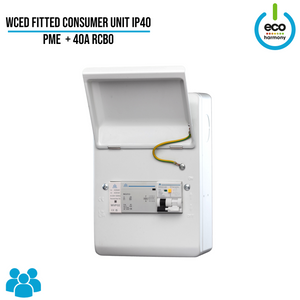

Fitted Consumer Unit IP40 – PME + 40A RCBO (Surge Protection + kWh Meter + Load Balancing Options Available)
Regular price From £80.00Regular price -
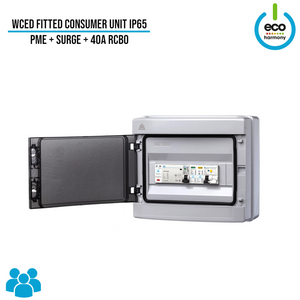

PEN Fault Detection + Surge Protection Device
Regular price From £77.50Regular price -
Save £2.50
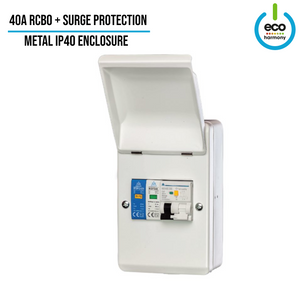

RCBO + Surge Protection Fitted Consumer Unit (IP30 / Indoor Use)
Regular price £32.50Regular price£35.00-£2.50 Sale price £32.50 -
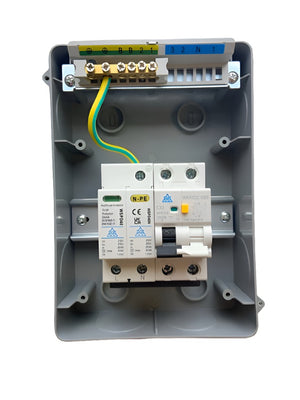

IP65 Consumer Unit with RCBO + Type 2 Surge Protection
Regular price £33.50Regular price£26.00Sale price £33.50


-


Simpson & Partners Cable Hook – Keep Your Charger Tidy & Stylish
Regular price £60.00Regular price -
Save £30.00


Home Series 7kW EV Charger – Type 2 Socket
Regular price From £550.00Regular price£580.00-£30.00 Sale price From £550.00 -


Home Series 7 kW Home EV Charger, Type 2 Tethered
Regular price From £620.00Regular price -


Free Colour Sample Card – Simpson & Partners EV Chargers
Regular price £0.00Regular price -
Sold out


Simpson & Partners Wireless Energy Manager – Smarter, Safer Charging
Regular price From £95.00Regular price


