PEN protection for EV chargers: your questions answered
If you're installing or buying an EV charger in the UK, PEN fault protection is one of the most important safety decisions you'll make — and also one of the most misunderstood. This guide answers the questions installers and homeowners ask most often, clearly and without jargon.
What does PEN stand for?
PEN stands for Protective Earth and Neutral. In certain electrical supply systems — specifically TN-C-S systems, which are the most common in UK residential and commercial properties — the neutral and earth conductors are combined into a single conductor up to the point of entry at your property. This shared conductor is called the PEN conductor.
The system is called PME (Protective Multiple Earthing) and it works well under normal conditions. The risk arises when the PEN conductor becomes damaged or disconnected.
What is a PEN fault and why is it dangerous?
A PEN fault occurs when the combined neutral and earth conductor breaks or loses continuity. When this happens, the electrical system's earth reference disappears. Instead of safely carrying fault current away, the exposed metalwork of anything connected to the system — including your EV and the charger itself — can rise to a dangerous voltage relative to true earth.
In practical terms: a person touching an EV during a PEN fault could receive a severe or fatal electric shock. The vehicle looks completely normal. There is no warning.
This is why BS 7671:2018 Amendment 2 (the IET Wiring Regulations) introduced specific requirements for PEN fault protection on EV chargers.
What does BS 7671 actually require?
Section 722.411.4.1 of the wiring regulations states:
"A PME earthing facility shall not be used as the sole means of protective earthing for an EV charging point located outdoors unless either a supplementary earth electrode is provided or a suitable PEN fault detection device is installed."
The key points are:
- Outdoor EV chargers on PME supplies must have additional protection beyond the PME earth.
- That protection can be either an earth rod (supplementary earth electrode) or a PEN fault detection device.
- Installers are legally required to comply — this is not optional guidance.
Additional relevant regulations include 722.531.101 (user-accessible metal parts must not pose shock hazards) and 411.3.2 (protective conductors must be continuous and not rely solely on PME).
Do you need a PEN fault device or an earth rod?
Both achieve the same regulatory outcome by different means. The right choice depends on site conditions.
| Earth rod | PEN fault detection device |
|---|---|
| Provides a separate path to earth independent of the PME system | Monitors the supply and disconnects the charger if a PEN fault is detected |
| Passive — no electronics, nothing to maintain | Active — continuously monitors voltage and disconnects within seconds of a fault |
| Requires suitable ground conditions (rocky or paved ground can make installation difficult or expensive) | Works in any ground condition, no excavation required |
| Must achieve 15Ω or lower resistance to earth — this must be measured and recorded | Requires periodic functional testing but no ground resistance measurement |
| Converts the installation to a TT system | Keeps the installation on the PME system but provides automatic disconnection |
In many urban or suburban installations where the ground is paved or built over, a PEN fault detection device is the more practical solution. On properties with accessible soft ground, an earth rod can be a straightforward and cost-effective choice.
Do chargers with built-in PEN protection still need an earth rod or external device?
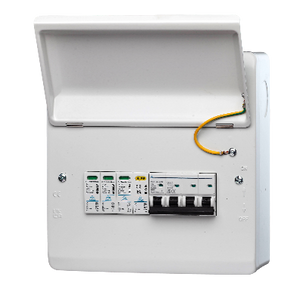
Some EV chargers include integrated PEN fault detection — the Simpson & Partners Home Series is a well-known example. Where a charger has verified, compliant built-in detection, an external device or earth rod is not required, because the charger itself fulfils the regulation.
However, installers should verify this claim against the manufacturer's technical documentation rather than taking it on face value. The charger's built-in protection must specifically address the open PEN scenario under BS 7671 Section 722 — not just standard RCD or overcurrent protection.
What is a 3-phase PEN fault detection device and when do you need one?
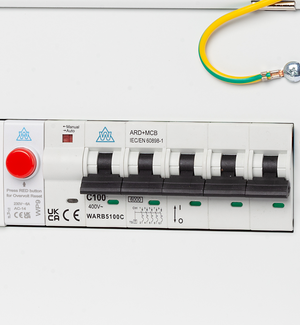
For single-phase EV chargers (7.4kW and below), a single-phase PEN fault detection device monitors the live and neutral on a 230V supply. For three-phase chargers (11kW and above, including 22kW units), you need a device that monitors all three phases and the neutral on a 400V supply.
A 3-phase PEN fault detection device can also protect multiple chargers simultaneously from a single upstream installation point — making it an efficient solution for multi-charger or commercial sites.
How quickly does a PEN fault detection device disconnect?
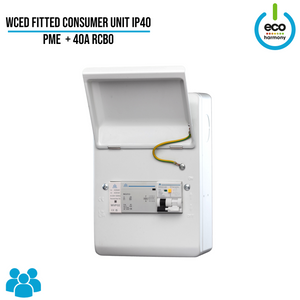
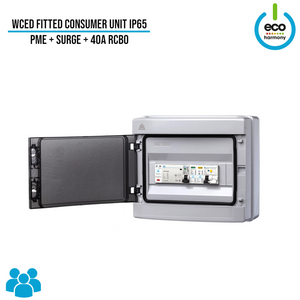
Under BS 7671, the maximum disconnection time for fault protection in a 230V TN system is 0.4 seconds for circuits supplying socket outlets. In practice, most quality PEN fault detection devices — including the WCED units in the Eco Harmony range — disconnect within 5 seconds of detecting an out-of-range voltage condition, and automatically reset once normal supply is restored (for under-voltage events). Over-voltage events require a manual reset for safety.
Can one PEN fault device protect multiple EV chargers?
Yes — a correctly rated device installed upstream of multiple chargers will protect all of them simultaneously. This is common in commercial installations and multi-unit residential developments. If the chargers are on separate circuits or supplied from different points, each supply arrangement must be assessed individually.
What happens if a PEN fault device trips?
The device disconnects the supply to the charger. Charging stops. The vehicle remains safe. Once the supply condition normalises (for under-voltage), most devices automatically reconnect. If the fault was an over-voltage event, the device requires a manual reset — this prevents automatic reconnection into a potentially damaged supply.
If your device is tripping regularly, this indicates an underlying supply issue that should be investigated by a qualified electrician. Repeated tripping should never be ignored or bypassed.
Do I need to test my PEN fault detection device?
Yes. Functional testing should be carried out at commissioning and periodically thereafter — annually is a reasonable interval for most installations, or after any significant electrical work on the supply. Some advanced devices log disconnection events, which can help identify intermittent supply problems over time.
Summary
PEN fault protection is a legal requirement for outdoor EV chargers on PME supplies in the UK. The two compliant solutions are an earth rod achieving 15Ω or below, or a suitable PEN fault detection device. Chargers with verified built-in detection are also compliant without additional hardware. The right choice depends on site conditions, charger specification, and the number of chargers being protected.
All installation, commissioning, and testing must be carried out by a qualified electrician in accordance with BS 7671 and current building regulations.